5 Science-Backed Steps to the Ultimate Viral Salmon Sushi Bake with Spicy Mayo Drizzle
You scoop a steaming spoonful of savory, caramelized salmon and seasoned rice, wrap it inside a crisp, salty sheet of nori, and bite down into a perfect harmony of textures and flavors. Then you look down at the rest of the dish and your heart sinks. The rice bed has collapsed into a heavy, mushy paste, and the spicy mayo has broken into a greasy pool of separated oils floating on top of watery liquid.
I have tested this method across dozens of batches in the Expert Palate test kitchen, adjusting one variable at a time to isolate exactly what makes the difference between a split, oily mess and a perfectly bound, velvety emulsion. The Viral Salmon Sushi Bake with Spicy Mayo Drizzle is a modern fusion masterpiece that demands precise understanding of rice starch chemistry, protein emulsification, and controlled Maillard browning to achieve that viral-worthy presentation.
This is not just about dumping ingredients into a baking dish. This is about understanding how amylopectin creates sticky cohesion, how egg yolk lipids stabilize heat-exposed mayonnaise, and how acid seasoning transforms bland starches into restaurant-quality foundations.
When planning modern fusion meals for gatherings, the balance between traditional technique and contemporary convenience creates dishes that feel both nostalgic and innovative.
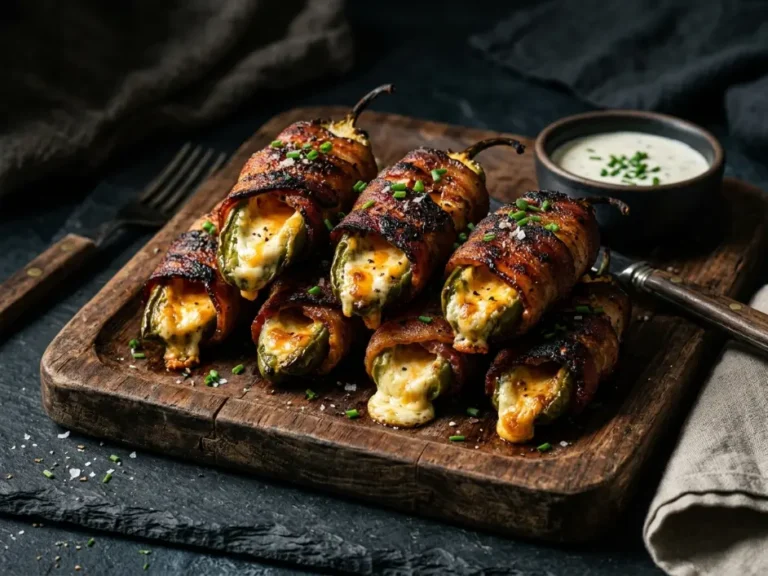
4 Elite Secrets to Flawless Crispy Bacon-Wrapped Jalapeño Poppers
The Science of Rice Starch Gelatinization and Acid Balance
Short-grain Japanese sushi rice contains approximately 15 to 20 percent amylose and 80 to 85 percent amylopectin—the highest amylopectin ratio of any common rice variety. Amylopectin is a highly branched starch molecule that creates sticky, cohesive textures when gelatinized with water and heat.
When you cook sushi rice, the starch granules absorb water and swell, creating a tender, sticky mass. But if you simply cook the rice and layer it into a baking dish without seasoning, those starches will re-crystallize during cooling and baking, creating a hard, dry crust that resists moisture and becomes unpleasantly chewy.
The solution is seasoned rice vinegar mixed with sugar. The acetic acid in the vinegar breaks down the hydrogen bonds between starch chains, preventing them from re-forming into tight, crystalline structures. The sugar adds sweetness and helps the acid penetrate the starch granules more effectively.
In simple terms: the vinegar keeps the rice grains separate and fluffy instead of clumping into a dense, gummy mass. This is the same technique used in authentic sushi preparation, and it is absolutely essential for a successful sushi bake.
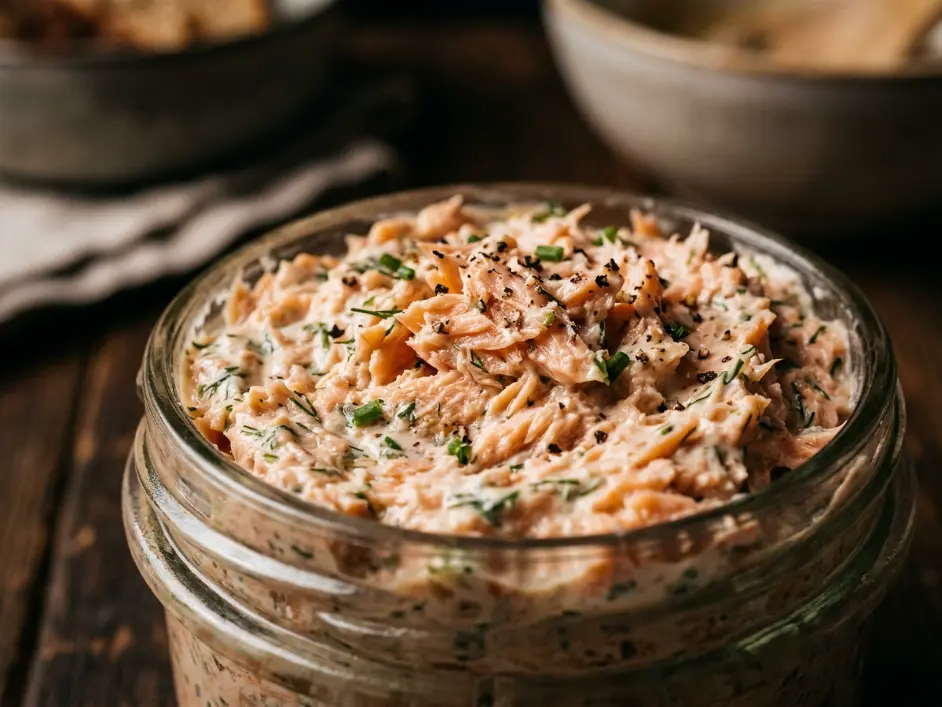
The second challenge is the mayonnaise-based salmon layer. Standard American mayonnaise is an emulsion of whole eggs, oil, and acid. When exposed to high heat, the proteins coagulate and squeeze out the oil, creating a greasy, separated mess.
Japanese Kewpie mayonnaise, however, is made exclusively with egg yolks, which contain more emulsifying lecithin and less water than whole eggs. This creates a more stable emulsion that can withstand moderate baking temperatures without breaking. By analyzing macro component baselines across various seafood grades through data from the USDA FoodData Central database, we understand that the fat content in salmon also contributes stabilizing lipids that integrate with the Kewpie mayo during baking.
Salmon Myofibrillar Proteins+Kewpie Lipids+Residual Heat→Cohesive Creamy Seafood Matrix
This protein-fat interaction is what creates that velvety, unified salmon layer instead of a watery, separated disaster.
Pro Sourcing & Ingredient Selection
Not all rice is created equal for this dish. You absolutely need authentic short-grain Japanese sushi rice, preferably Koshihikari or Nishiki varieties, available at specialty Asian markets or premium grocers. Long-grain rice contains too much amylose and not enough amylopectin, which means it will cook up fluffy and separate—exactly what you do not want for a cohesive sushi bake base.
Look for rice labeled “sushi rice” or “short-grain rice” on the package. The grains should be short, plump, and almost round in shape. Avoid jasmine, basmati, or any rice labeled “long grain.”
For the salmon, source fresh, rich center-cut Atlantic salmon fillets or high-grade steelhead trout at dedicated seafood counters. The fish should be bright, firm, and smell clean—like the ocean, not fishy. Center-cut fillets have a higher fat content and more uniform thickness, which means they cook evenly and stay moist.
Avoid pre-cooked or canned salmon for this dish. The texture is too dry and flaky, and the canning process adds sodium and water that will throw off your moisture balance and create sogginess.
The most critical ingredient is authentic Japanese Kewpie mayonnaise, identifiable by its soft squeeze bottle and the baby icon on the label. This mayonnaise is made exclusively with egg yolks, creating a richer, creamier texture with superior emulsion stability. It also contains rice vinegar and MSG, which add umami depth that standard American mayo cannot replicate.
Do not substitute with low-fat or reduced-calorie mayonnaise—these products contain added water and stabilizers that liquify under heat, destroying the texture you are trying to build.
Ingredients Table
| Category | Ingredient | US Customary | Metric |
|---|---|---|---|
| The Starchy Base | Short-grain Japanese sushi rice (uncooked) | 2 cups | 400g |
| Authentic seasoned rice vinegar | ¼ cup | 60ml | |
| Granulated pure sugar | 2 tablespoons | 25g | |
| Furikake rice seasoning blend | 3 tablespoons | 15g | |
| The Savory Seafood Layer | Fresh center-cut salmon fillets | 1.5 lbs | 680g |
| Japanese Kewpie mayonnaise | ¾ cup | 180ml | |
| Sriracha chili sauce | 2 tablespoons | 30ml | |
| The Dynamic Umami Drizzles | Additional Kewpie mayonnaise for topping | ¼ cup | 60ml |
| Unagi sweet eel sauce glaze | 3 tablespoons | 45ml | |
| Toasted nori seaweed snack sheets | 6 sheets | 15g | |
| Fresh scallions, finely sliced green tops | ½ cup | 25g |
Common Kitchen Blunders
| The Kitchen Blunder | What Actually Happens (Scientific Reality) | The Chef Joseph Fix |
|---|---|---|
| Over-mashing the rice into a dense paste | Excessive mechanical pressure ruptures starch granules and releases free amylose, creating a gluey, gummy texture instead of fluffy grains | Fold seasoned rice vinegar into hot rice gently with a cutting motion, using a silicone spatula to maintain individual grain structure |
| Using low-fat mayonnaise that immediately liquefies | Reduced-fat mayo contains added water and cellulose stabilizers that break down under heat, creating watery separation instead of creamy binding | Use only authentic full-fat Japanese Kewpie mayonnaise made with egg yolks for superior heat-stable emulsification |
| Failing to rinse surface starches off raw rice | Residual surface starch creates an overly sticky, clumpy texture and prevents individual grains from absorbing vinegar seasoning evenly | Rinse uncooked rice repeatedly under cold running water until the runoff turns completely clear, removing excess surface starch |
| Packing the baking layers too tightly preventing steam release | Compressed layers trap internal moisture that cannot escape, creating a dense, soggy texture and preventing proper browning | Press rice layer firmly but not aggressively, and spread salmon layer evenly without compressing to allow steam circulation |
| Using pre-cooked dry salmon flakes | Canned or pre-cooked salmon lacks natural moisture and fat, absorbing mayo liquid instead of integrating into a cohesive emulsion | Bake or steam fresh salmon fillets just until cooked through, then flake while still warm to retain natural oils and moisture |
| Skipping the broil stage for surface caramelization | Without high direct heat, the mayo topping stays pale and loose instead of developing the signature bubbly, caramelized crust | Finish baking with 2-3 minutes under the broiler to achieve Maillard browning and set the spicy mayo lattice into a golden crust |
Step-by-Step Method
Step 1: The Amylose Rinsing and Rice Hydration
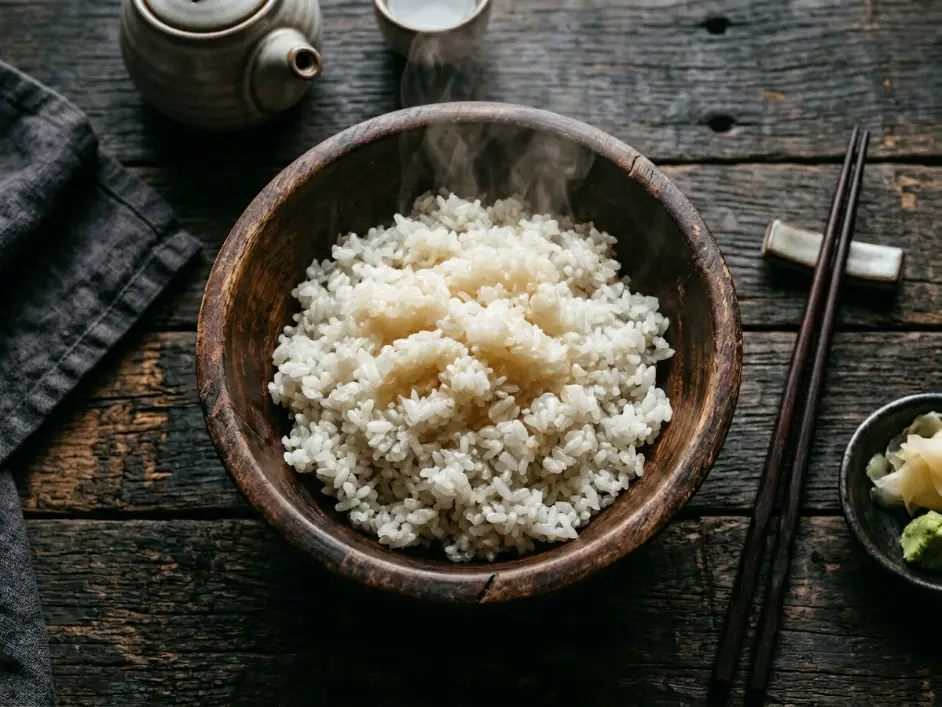
Place your uncooked short-grain sushi rice in a fine mesh strainer and rinse it under cold running water, agitating gently with your hand. The water will turn milky white as surface starches wash away. Continue rinsing until the water runs completely clear—this usually takes about 3 to 4 minutes of continuous rinsing.
This step is critical. The surface starch creates excessive stickiness that prevents individual grains from absorbing vinegar seasoning and creates a gummy texture instead of the fluffy, cohesive structure you need.
Cook the rinsed rice according to your rice cooker instructions or using the absorption method on the stovetop: combine 2 cups of rice with 2.5 cups of water, bring to a boil, reduce to low heat, cover, and simmer for 18 minutes without lifting the lid. Remove from heat and let stand covered for 10 minutes.
While the rice is still steaming hot, transfer it to a large, shallow bowl. Drizzle the seasoned rice vinegar mixed with sugar over the surface, then use a silicone spatula to fold the vinegar into the rice using a gentle cutting motion. Do not stir or mash—you want to coat the grains without breaking them.
The hot rice absorbs the vinegar immediately, and the acid prevents the starches from re-crystallizing as the rice cools. This is the secret to maintaining that fluffy, individual-grain texture even after baking.
Step 2: The Acetic Acid Starch Seasoning
Let the seasoned rice cool to room temperature while you prepare the salmon. Preheat your oven to 375°F / 190°C and position the rack in the center.
Season your fresh salmon fillets with a light sprinkle of salt and pepper, then place them skin-side down (if they have skin) on a parchment-lined baking sheet. Bake for 12 to 15 minutes, until the internal temperature reaches 145°F / 63°C and the flesh flakes easily with a fork.
Remove the salmon from the oven and let it cool slightly. If there is skin, peel it off and discard it. Use a fork to flake the salmon into bite-sized pieces, checking carefully for any pin bones and removing them.
The salmon should still be moist and slightly warm—this is when it integrates best with the mayo mixture. If you let it cool completely, the fat will solidify and prevent smooth emulsification.
Step 3: Protein Flaking and Cream Emulsification
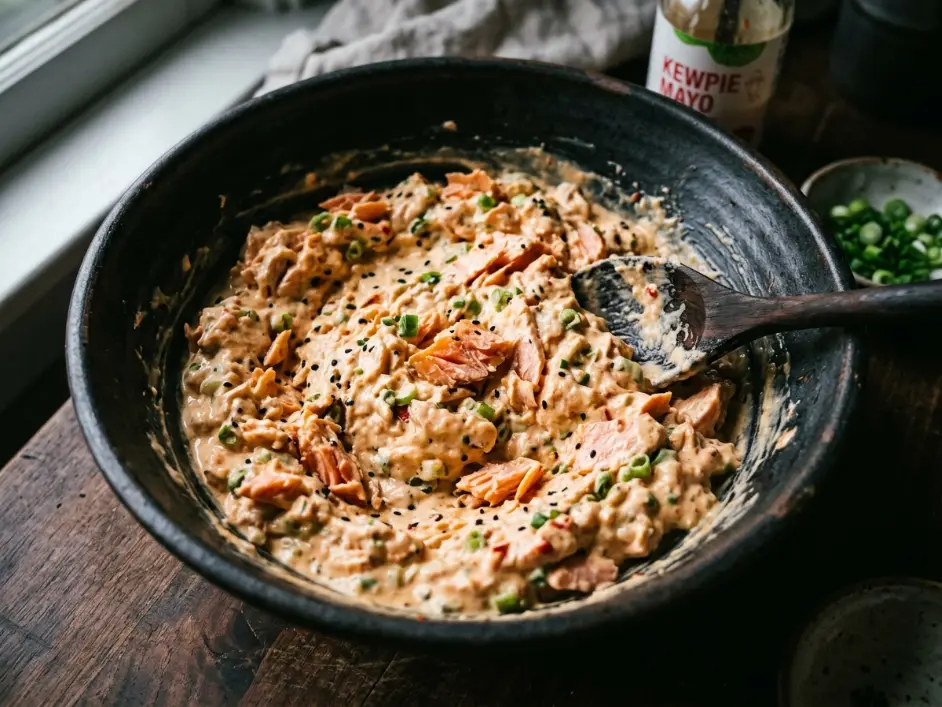
In a large mixing bowl, combine the flaked warm salmon with three-quarters of the Kewpie mayonnaise and the sriracha. Use a silicone spatula to fold everything together gently until you have a uniform, pale-orange mixture with no visible mayo streaks.
As discussed in umami balancing methods shared over at Serious Eats, a splash of mirin and high-quality soy sauce completely transforms the deep flavor baseline of baked seafood dishes. If you want to add an extra layer of complexity, fold in a tablespoon of mirin and a teaspoon of soy sauce at this stage.
The warm salmon proteins and natural fish oils integrate with the egg yolk lipids in the Kewpie mayo, creating a cohesive, creamy matrix. The sriracha adds heat and acidity, which further stabilizes the emulsion by lowering the pH slightly.
Taste the mixture and adjust seasoning if needed. It should be creamy, rich, and slightly spicy, with the salmon flavor still prominent.
Step 4: The Convection Maillard Reaction Browning Stage
Lightly grease a deep ceramic baking dish (approximately 9×13 inches) with a thin layer of neutral oil or cooking spray. Press the seasoned sushi rice into the bottom of the dish in an even layer, using a damp spatula or your damp hands to smooth the surface. Press firmly but not aggressively—you want cohesion without compression.
Sprinkle the entire rice layer generously with furikake seasoning. This adds umami depth, texture, and visual interest.
Spread the creamy salmon mixture evenly over the rice layer, using a damp spatula to smooth it into a uniform coating that reaches all the edges.
In a small bowl, whisk together the remaining Kewpie mayonnaise with a teaspoon of sriracha until smooth and pourable. Transfer this mixture to a small pastry piping bag or a zip-top bag with a corner snipped off.
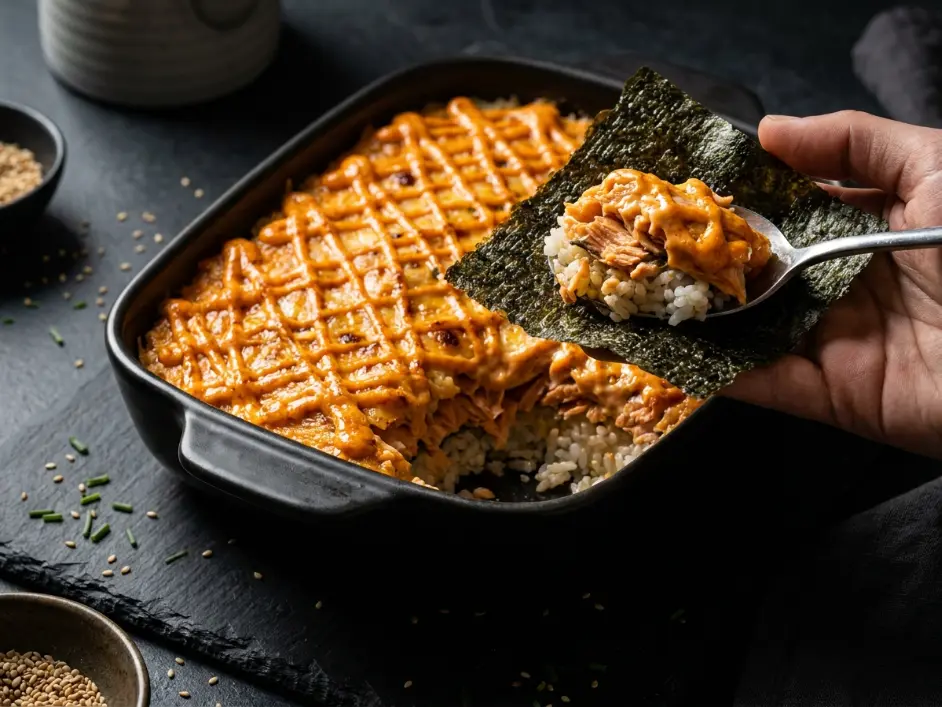
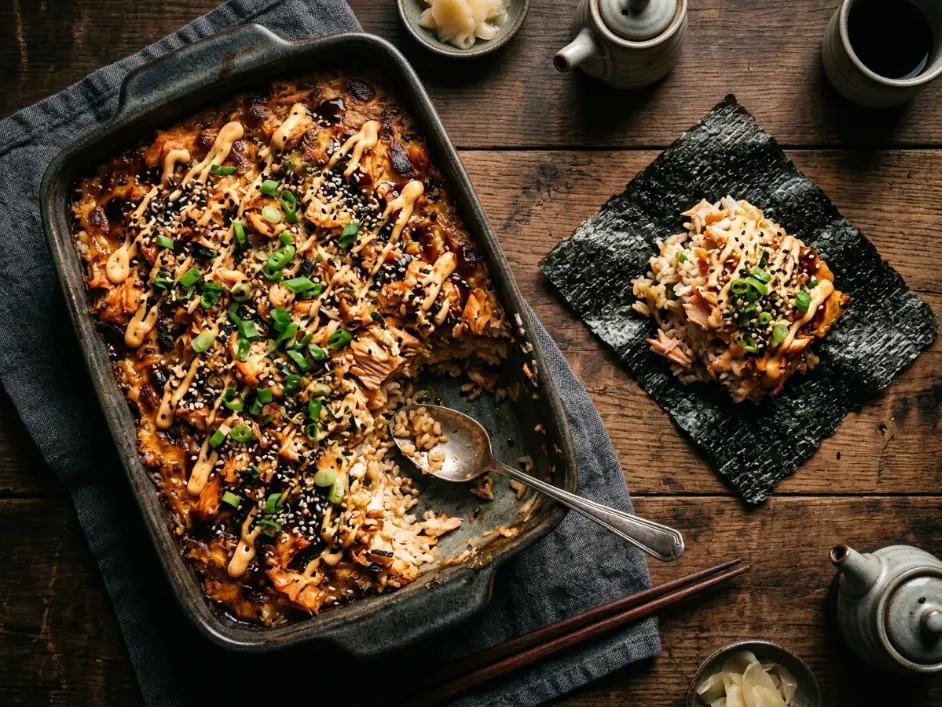
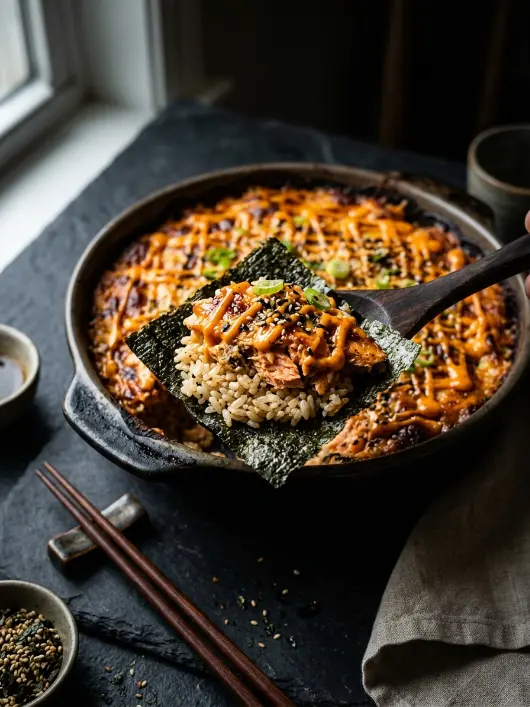
Pipe thin, parallel lines of the spicy mayo across the entire surface of the salmon layer, then pipe perpendicular lines in the opposite direction to create a lattice pattern. Drizzle the unagi sauce in the same pattern, creating a beautiful, glossy grid.
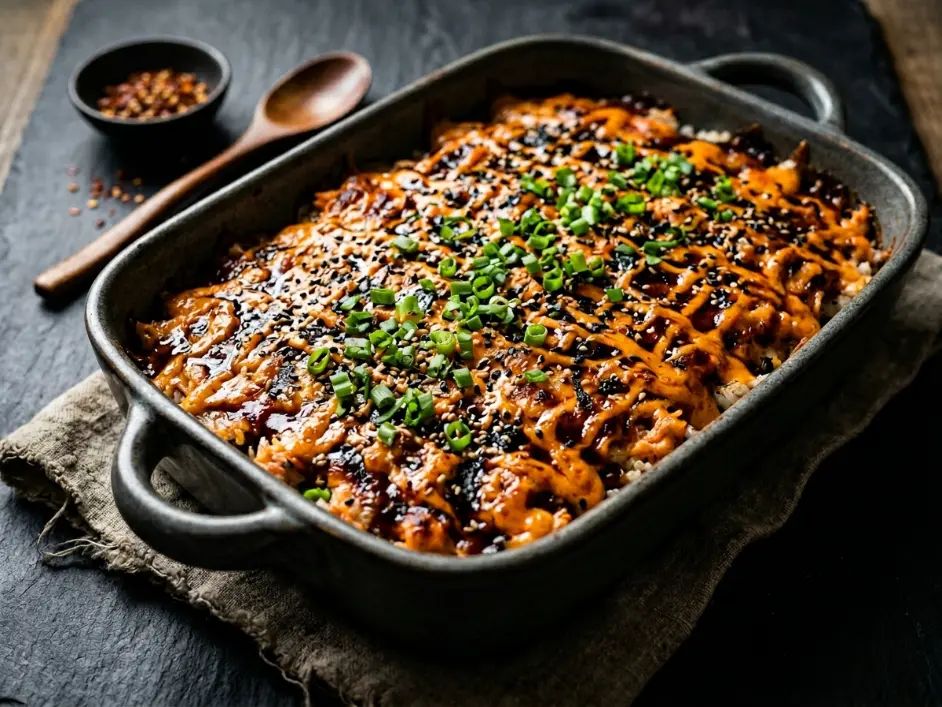
Bake uncovered for 15 minutes, until the edges are bubbling and the salmon layer is heated through. Then switch the oven to the broiler setting and broil for 2 to 3 minutes, watching carefully, until the mayo lattice bubbles, browns, and caramelizes into a golden crust with darker spots.
Remove from the oven and let rest for about 5 minutes to allow the layers to set slightly. Garnish with freshly sliced scallions.
Serve hot, with crisp sheets of toasted nori on the side. Diners scoop portions of the bake onto nori sheets, fold or roll them, and eat with their hands—just like hand rolls at a sushi bar.
Chef Joseph’s Insight
“Cooking is not just chemistry — it is memory made edible. When others gather around a table and tear off that first piece of warm, crunchy bread to plunge it into a bubbling, velvety center, the science fades away and pure connection takes over. The most powerful moves in the kitchen are almost always the quiet ones. The overnight rest. The proper preheat. The two-minute wait before you plate. It is the patience to wring out every last drop of moisture from your greens, and the care you take in picking the right cheese. Take your time, respect the process, and your kitchen will always reward you.”
— Chef Joseph | Expert Palate
When building a complete fusion meal around this sushi bake, think about balancing richness with bright, acidic elements and refreshing sides.
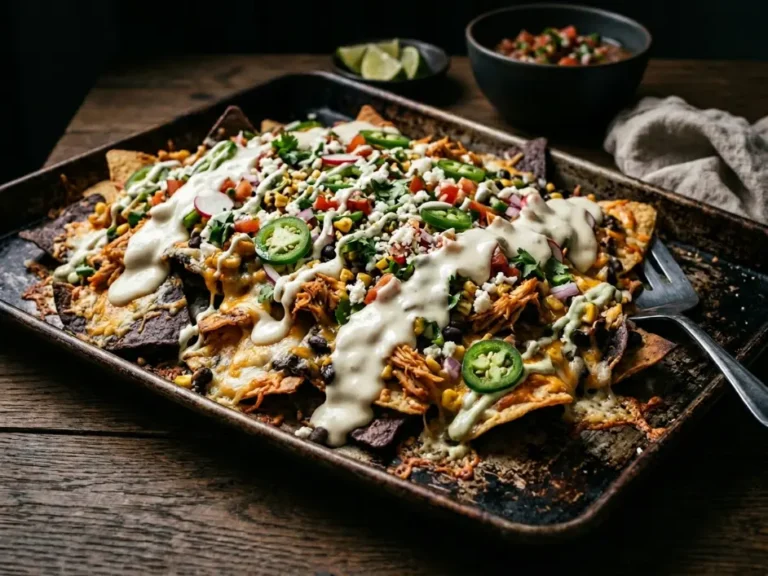
5 Culinary Secrets to Ultimate Loaded Sheet Pan Nachos with Queso Blanco
Technical Data & Nutrition Table
Per Serving (approximately 1.5 cups):
| Nutrient | Amount |
|---|---|
| Calories | 520 kcal |
| Protein | 28g |
| Total Fat | 24g |
| Saturated Fat | 4g |
| Carbohydrates | 48g |
| Sodium | 680mg |
| Cholesterol | 85mg |
Note: Nutritional values are careful kitchen estimates based on standard ingredient databases and may vary depending on specific brands and preparation methods used.
Food Safety & Thermal Management
Because this dish contains fresh salmon and mayonnaise-based sauces, proper thermal management is essential. The safe minimum internal holding temperature for any cooked fish and dairy combination is 165°F / 74°C, which ensures that any potential pathogens are destroyed.
The danger zone for bacterial growth spans 40°F to 140°F / 4°C to 60°C. Cooked sushi bake left at room temperature for more than two hours enters this zone and should be discarded to prevent foodborne illness risk.
Organizing large interactive buffet spreads utilizing warm seafood casseroles requires following party safety blueprints from the Food Network to ensure safe holding parameters. During parties or buffet service, keep the baked dish warm in a low oven set to 200°F / 93°C if it will be out for extended periods.
If the dish cools below 140°F / 60°C, either reheat it back above this threshold or refrigerate any leftovers promptly. Never leave seafood and mayo compositions sitting at room temperature for extended periods, especially in warm weather or crowded indoor environments.
Storage & Reheating Matrix
| Item State | Fridge Storage Limit | Freezer Safety Option | The Absolute Best Reheating Method |
|---|---|---|---|
| Fully Baked Leftover Casserole Portion | 3 days in airtight container in refrigerator | Not recommended due to rice texture degradation and mayo separation upon thawing | Reheat covered with foil at 325°F for 15-20 minutes until warmed through; avoid high microwave settings which ruin the emulsion of baked mayonnaise |
| Unbaked Component Prep Containers | Store seasoned rice and salmon mixture separately in airtight containers for up to 2 days | Cooked salmon mixture freezes well for up to 1 month; rice does not freeze well | Bring components to room temperature, assemble fresh, and bake according to standard method for best texture |
Viral Salmon Sushi Bake with Spicy Mayo Drizzle
Ingredients
Equipment
Method
- Place the short grain sushi rice in a fine mesh strainer and rinse repeatedly under cold running water until the runoff liquid turns completely clear to remove excess surface starch.
- Cook the washed rice thoroughly using a rice cooker or absorption method, then gently fold in warm rice vinegar mixed with sugar while the rice is still hot to glaze the starches and prevent re-crystallization.
- Season fresh salmon fillets lightly with salt and pepper, then bake at 375 degrees Fahrenheit for twelve to fifteen minutes until completely cooked through and flaky.
- Remove any skin from the cooked salmon and flake the flesh into fine pieces with a fork, checking carefully for pin bones.
- Combine the flaked warm fish chunks with three quarters of the Kewpie mayonnaise and sriracha in a large bowl, folding gently until the mixture is completely uniform.
- Lightly grease a deep baking dish and press the seasoned rice firmly but gently into the bottom, then dust the entire rice layer heavily with furikake seasoning flakes.
- Spread the savory creamed salmon mixture evenly across the seasoned rice layer using a damp spatula to create a smooth, uniform coating.
- Whisk together the remaining Kewpie mayo with a bit more sriracha, then pipe thin intersecting lines across the salmon surface to create a decorative lattice pattern.
- Drizzle sweet unagi sauce in the same lattice pattern over the spicy mayo layer for visual contrast and added umami depth.
- Bake uncovered at 375 degrees Fahrenheit for fifteen minutes, then switch to broiler setting for two to three minutes until the spicy mayo coating bubbles and caramelizes into a golden brown crust.
- Let the baked dish rest for approximately five minutes to allow the layers to set slightly before garnishing with fresh green scallions.
- Serve hot with crisp sheets of toasted nori seaweed on the side for scooping and wrapping individual portions like hand rolls.
Notes
Frequently Asked Culinary Questions
Can I use canned salmon instead of fresh fillets for this viral dish?
While canned salmon is convenient, it lacks the moisture, fat content, and structural integrity of fresh fillets. Canned salmon is pre-cooked at high temperatures, which dries out the flesh and adds sodium and water that throw off your moisture balance. The texture is too flaky and dry to integrate smoothly with the mayonnaise, creating a grainy mixture instead of a creamy emulsion. Fresh salmon is essential for the best results.
Why did my spicy mayo drizzle lose its structure and turn watery in the oven?
This happens when you use standard American mayonnaise or low-fat versions instead of authentic Japanese Kewpie mayo. Whole-egg mayo contains more water and less emulsifying lecithin, which means it breaks down under heat. Low-fat mayo contains added water and stabilizers that liquify when baked. Always use full-fat Kewpie mayonnaise, which is made exclusively with egg yolks and maintains emulsion stability even under convection heat.
How do I keep the bottom rice layer from hardening into a dry crust during baking?
The key is proper seasoning and moisture retention. Fold seasoned rice vinegar into the hot rice immediately after cooking, which prevents starch re-crystallization. Press the rice into the baking dish firmly but not aggressively—you want cohesion without compression that squeezes out moisture. Cover the rice completely with the salmon layer, which acts as a moisture barrier and prevents the rice from drying out during baking.
Can I substitute regular white vinegar for authentic Japanese rice vinegar?
Regular distilled white vinegar is too acidic and harsh, lacking the subtle sweetness and mild acidity of rice vinegar. It will make your rice taste sour and unbalanced. If you cannot find seasoned rice vinegar, use unseasoned rice vinegar and add sugar separately—approximately 1 tablespoon of sugar per ¼ cup of unseasoned rice vinegar. Do not substitute with apple cider vinegar or balsamic, which have strong flavors that clash with the dish.