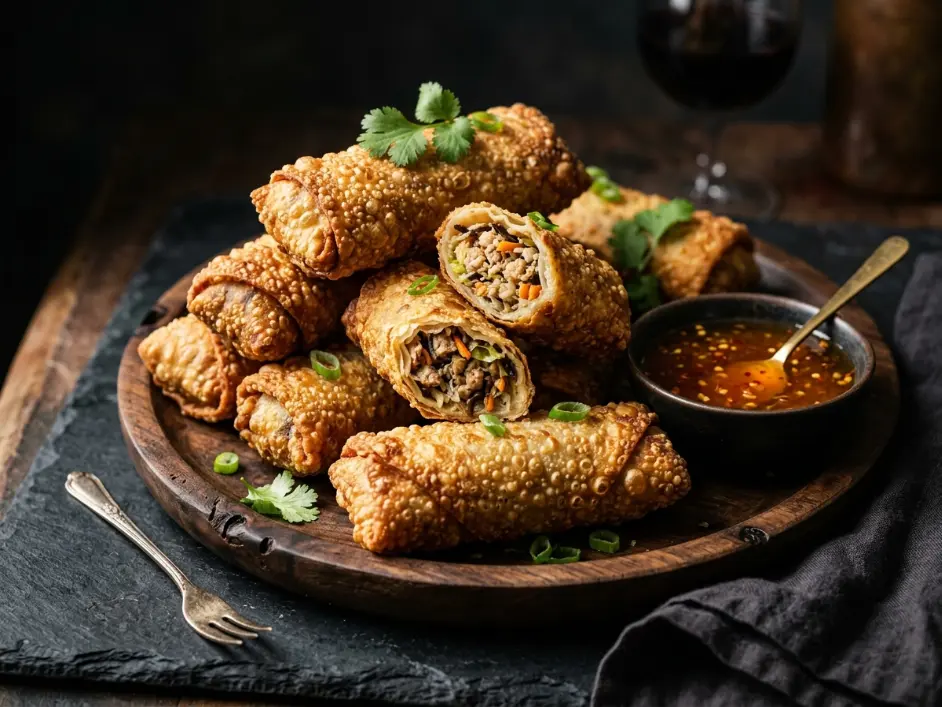
The Deep-Fry Thermodynamics Behind Homemade Crispy Pork and Vegetable Egg Rolls
You bite down into a blistered, crackling pastry casing that shatters effortlessly, releasing a rush of savory steam and tender pork mingled with crisp vegetable threads. Then you look at the rest of the batch and your heart sinks. Limp, oil-logged wrappers weeping internal moisture, their seams split open like geological faults, the vegetable filling having bled steam during cooking and turned the golden promise into a greasy, soggy disappointment.
I have tested this method across dozens of batches in the Expert Palate test kitchen, adjusting one variable at a time to isolate exactly what makes the difference between a split, oily mess and a perfectly bound, velvety emulsion. Homemade Crispy Pork and Vegetable Egg Rolls are a masterclass in moisture management, vapor pressure control, and thermal dynamics—transforming simple ingredients into restaurant-quality dim sum that rivals anything you can order.
This is not just about wrapping and frying. This is about understanding how cellular water content destroys structural integrity, how oil temperature governs starch gelatinization, and how strategic dehydration creates the shattering texture you crave.
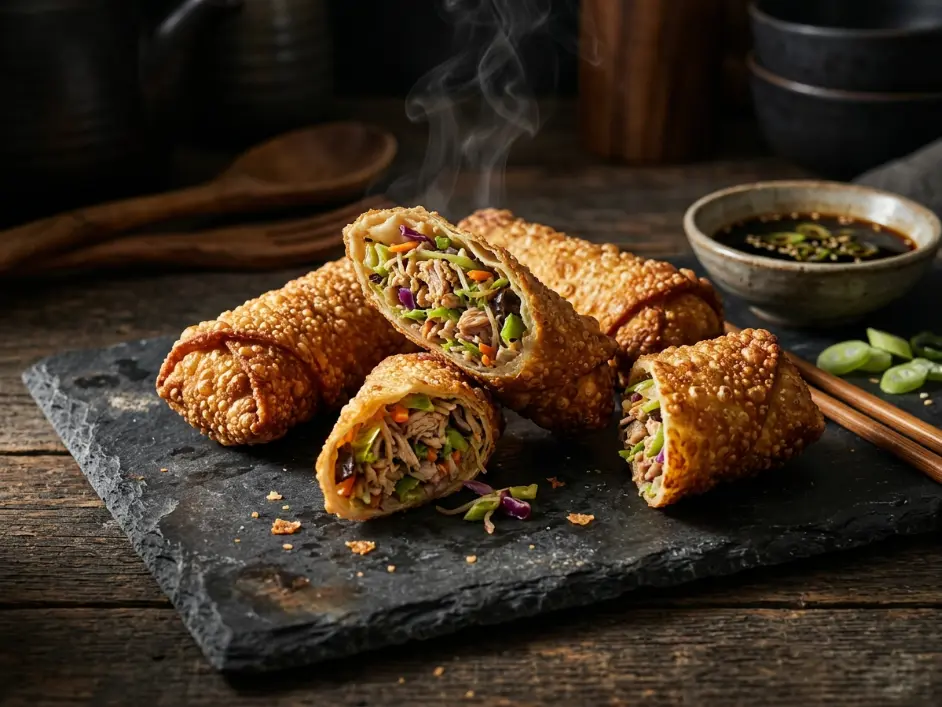
When planning takeout-inspired spreads or casual appetizer platters, the balance between shattering exteriors and tender, flavorful interiors creates finger foods that disappear faster than you can fry them.
Decoding the Science of a Perfectly Emulsified Creamy Buffalo Chicken Dip with Tortilla Chips
The Chemistry of Vegetable Osmosis and Vapor Pressure
Cabbage and carrots are approximately 90 to 95 percent water by weight. When you heat these vegetables rapidly during deep frying, the cellular walls fracture and release free-standing water molecules. As the internal temperature climbs past 212°F / 100°C, that water tries to convert to steam—expanding in volume by approximately 1,600 times.
This creates catastrophic vapor pressure inside your egg roll. The steam seeks escape routes, and the weakest structural points are the seams where the wrapper was sealed. The pressure builds, the seams split, and hot oil rushes into the filling, turning your egg roll into a greasy, collapsed tube.
The solution is osmotic dehydration before assembly. By tossing shredded vegetables with salt and allowing them to rest, you draw out cellular moisture through osmosis. The salt creates a concentration gradient that pulls water molecules out of the vegetable cells and onto the surface, where you can physically squeeze and drain them away.
By analyzing the water-to-protein mass balances of lean ground pork cuts through verified nutritional data from the USDA FoodData Central database, we understand that properly cooked and drained pork releases minimal moisture during frying, making it an ideal protein base when combined with dehydrated vegetables.
In simple terms: you are removing the water before it has a chance to turn into steam bombs inside your egg rolls. This keeps the filling dry, the wrapper intact, and the texture crisp.
Cellular Vegetable Matrix+Sodium (Salt Induction)→Exuded Surface Water+Crisp Dehydrated Fiber
The second critical factor is oil temperature. When you submerge a water-logged egg roll into 350°F oil, the moisture immediately tries to escape as steam, creating violent bubbling and structural failure. When you submerge a properly dehydrated egg roll into the same oil, the wrapper crisps instantly, creating a moisture barrier that seals the filling inside while allowing controlled steam release through micro-perforations.
Pro Sourcing & Ingredient Selection
The wrapper is your first critical decision. You need premium, thick-cut wheat flour egg roll wrappers from specialty Asian markets or top-tier grocers. These are substantively different from paper-thin spring roll skins, which are designed for fresh, uncooked applications.
Egg roll wrappers should feel substantial in your hand—slightly dry, with a matte surface and visible flour dusting. They should measure approximately 7 to 8 inches square and have a noticeable thickness. Avoid any wrappers that feel damp, sticky, or translucent.
For the pork, source high-quality lean ground pork or hand-minced pork shoulder from a specialty butcher counter. You want an 85/15 lean-to-fat ratio—enough fat for flavor and moisture, but not so much that it renders out excessively during cooking and creates grease pools in your filling.
Avoid pre-seasoned or pre-cooked ground pork, which often contains added water and preservatives that will sabotage your moisture control efforts.
The vegetables matter enormously. Choose firm, heavy green cabbage heads with tightly packed leaves and no soft spots. The cabbage should feel solid and dense when you pick it up. Avoid pre-shredded coleslaw mixes, which are industrially washed and retain excess moisture that is nearly impossible to remove through salting alone.
Select whole organic carrots with bright color and firm texture. The pre-shredded carrot sticks sold in bags are often treated with chlorine washes that add surface moisture. Hand-grating fresh carrots gives you complete control over texture and moisture content.
Ingredients Table
| Category | Ingredient | US Customary | Metric |
|---|---|---|---|
| The Pastry Shield | Thick square flour egg roll wrappers | 12 wrappers | 340g |
| Whole egg, whisked for wash adhesive | 1 large egg | 50g | |
| The Savory Protein Fill | Lean ground pork shoulder protein | 1 lb | 454g |
| Garlic cloves, microplaned | 4 cloves | 12g | |
| Fresh ginger root, grated minced | 1 tablespoon | 15g | |
| Premium soy sauce or tamari fluid | 2 tablespoons | 30ml | |
| Toasted sesame oil, concentrated | 1 teaspoon | 5ml | |
| The Aromatic Vegetable Crunch | Fresh green cabbage, finely shredded | 4 cups | 360g |
| Crisp whole carrots, julienned finely | 1 cup | 110g | |
| Fine sea salt for osmotic extraction | 2 teaspoons | 10g | |
| For Deep Frying | High smoke point peanut oil | 6 cups | 1.4L |
Common Kitchen Blunders
| The Kitchen Blunder | What Actually Happens (Scientific Reality) | The Chef Joseph Fix |
|---|---|---|
| Wrapping wet, un-drained filling inside the dough sheets | Cellular vegetable water converts to high-pressure steam during frying, rupturing wrapper seams and flooding the interior with oil | Salt vegetables heavily, rest for 15 minutes, then squeeze aggressively through cheesecloth or a fine mesh strainer to remove all free moisture |
| Rolling the egg rolls too loosely leaving internal air pockets | Air pockets expand violently when heated, creating structural weak points and uneven frying that leaves some areas soggy while others burn | Roll with steady, firm tension, pulling the wrapper taut around the filling and eliminating any visible gaps or loose folds |
| Frying in cold oil below 325 degrees causing severe oil logging | Low oil temperature prevents rapid starch gelatinization, allowing oil to permeate the wrapper before a crisp barrier forms, creating greasy, heavy egg rolls | Maintain oil temperature at a constant 350°F using a thermometer, frying in small batches to prevent temperature drops |
| Sealing wrapper edges with too much water instead of a stable egg wash adhesive | Excess water dilutes the starch adhesive and creates weak seals that fail under thermal stress during frying | Use a lightly whisked whole egg as a protein-based adhesive that coagulates under heat, creating a permanent seal |
| Piling hot fried rolls on top of each other which traps steam | Trapped steam condenses on the wrapper surface, turning the crisp coating soggy within minutes and ruining the texture | Rest fried egg rolls upright on a wire cooling rack with space between each piece to allow continuous air circulation |
| Overfilling the wrapper beyond structural capacity | Excessive filling creates pressure points that stress the wrapper, causing splits and blowouts even with perfect sealing technique | Use exactly 2 tablespoons of filling per wrapper—enough for flavor and substance without compromising structural integrity |
Step-by-Step Method
Step 1: The Osmotic Vegetable Dehydration
Place your finely shredded cabbage and julienned carrots in a large bowl. Sprinkle the fine sea salt evenly over the vegetables and toss thoroughly with your hands to ensure every shred is coated.
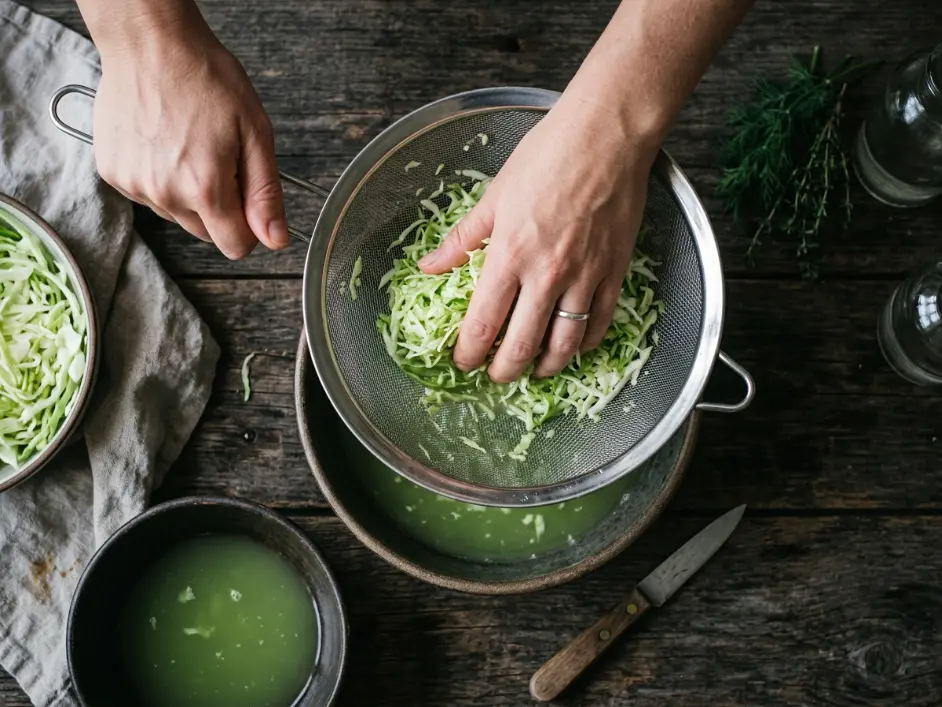
Let the salted vegetables rest at room temperature for 15 minutes. During this time, you will see water pooling at the bottom of the bowl as osmosis draws moisture out of the cellular structures.
After 15 minutes, transfer the vegetables to a fine mesh strainer or wrap them tightly in a double layer of cheesecloth. Squeeze aggressively, wringing and twisting to extract every possible drop of moisture. You should be able to remove at least a quarter cup of liquid from the vegetables.
The vegetables will look wilted and significantly reduced in volume, but they will be intensely flavored and completely dry—perfect for frying without creating steam pressure.
Step 2: The Searing and Moisture Evacuation of Proteins
Heat a large skillet or wok over high heat. Add the ground pork and break it into small crumbles with a wooden spoon or spatula. Cook without stirring for the first 2 minutes to develop a deep brown crust on the bottom.
Add the microplaned garlic and grated ginger, then stir-fry for 5 to 6 minutes total, breaking the pork into fine, uniform pieces. You want every bit of pink color gone and a rich, caramelized brown coating on the meat.
As discussed in depth and seasoning balance methods detailed over at Serious Eats, pre-cooking the aromatics with a touch of white pepper and toasted sesame oil stabilizes flavor structures during high-heat immersion frying.
Transfer the cooked pork to a fine mesh strainer set over a bowl. Press down firmly with the back of a spoon to drain away all rendered fat and cooking liquid. Let it sit for at least 5 minutes to ensure complete drainage.
In a large mixing bowl, combine the drained pork with the dehydrated vegetables. Add the soy sauce and toasted sesame oil, tossing gently to distribute the seasonings evenly. The filling should look dry and cohesive, not wet or glistening with liquid.
Let the filling cool to room temperature before assembling. Wrapping hot filling will create condensation inside the wrapper, defeating all your moisture removal efforts.
Step 3: The Envelope Diamond Tension Roll
Lay one egg roll wrapper on a clean, dry work surface in a diamond orientation—one corner pointing toward you, one pointing away.
Place exactly 2 tablespoons of the cooled, dry filling in the center of the lower third of the wrapper, forming a horizontal log shape about 4 inches long and 1 inch thick.
Fold the bottom corner up and over the filling, tucking it tightly underneath to create a firm base. This first fold is critical—it sets the tension for the entire roll.
Fold the left and right corners inward toward the center, creating an envelope shape. Press firmly to eliminate any air pockets.
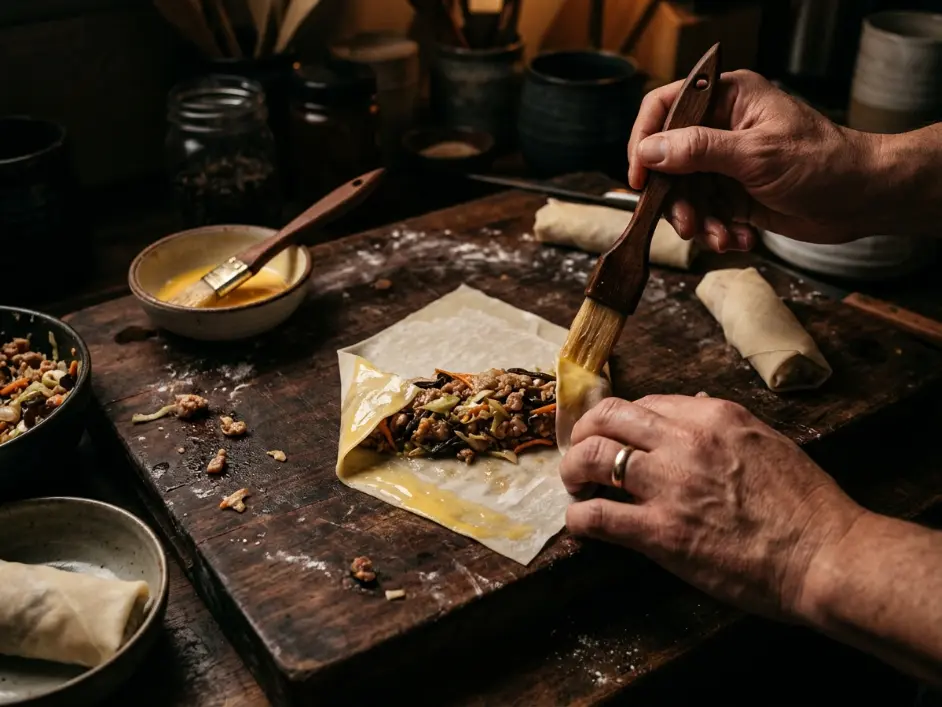
Lightly brush the top remaining corner with the whisked egg wash. This protein-based adhesive will coagulate under heat, creating a permanent seal.
Roll the cylinder forward with steady, firm tension, keeping the filling compact and the wrapper taut. When you reach the egg-washed corner, press firmly to seal.
The finished roll should feel firm and cylindrical, with no visible gaps, loose folds, or air pockets. Set it seam-side down on a parchment-lined tray and repeat with the remaining wrappers and filling.
Step 4: The Controlled Thermodynamic Deep Fry
Pour peanut oil into a large, heavy Dutch oven or deep fryer to a depth of at least 3 inches. Attach a deep-fry thermometer to the side of the pot, ensuring the probe is submerged in the oil but not touching the bottom.
Heat the oil over medium-high heat to exactly 350°F / 177°C. This temperature is critical—too low and the wrappers absorb oil, too high and they burn before the filling heats through.
Working in small batches of 3 to 4 rolls at a time, carefully lower the egg rolls into the hot oil using a wire spider strainer or slotted spoon. Do not overcrowd the pot, as this will drop the oil temperature and cause oil logging.
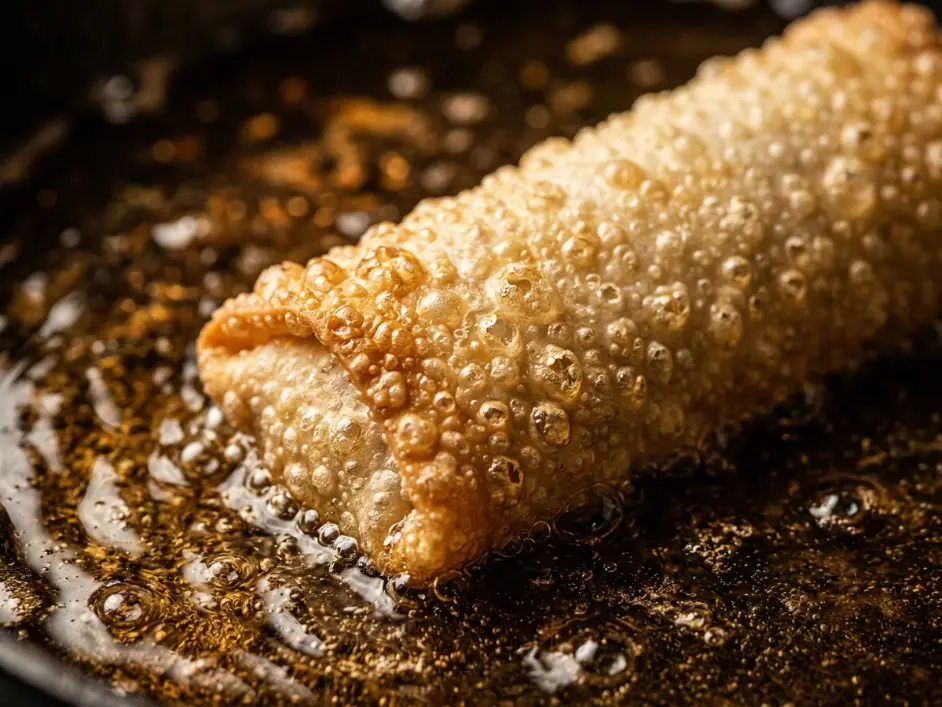
Fry for 5 to 6 minutes, turning the rolls continuously with tongs or a spider to ensure even browning on all sides. You are looking for a deep, uniform golden-brown color with visible blistering on the surface.
The blistering is a good sign—it indicates rapid moisture evaporation creating tiny steam pockets that puff the wrapper away from the filling, creating that shattering crispness.
Remove the fried egg rolls with a wire spider and transfer them to a wire cooling rack set over a sheet pan. Rest them upright or at an angle, not flat, to allow excess oil to drip away and steam to escape without condensing on the wrapper surface.
Let the oil temperature return to 350°F between batches. This usually takes about 2 minutes. Maintaining consistent oil temperature is the difference between crispy and greasy.
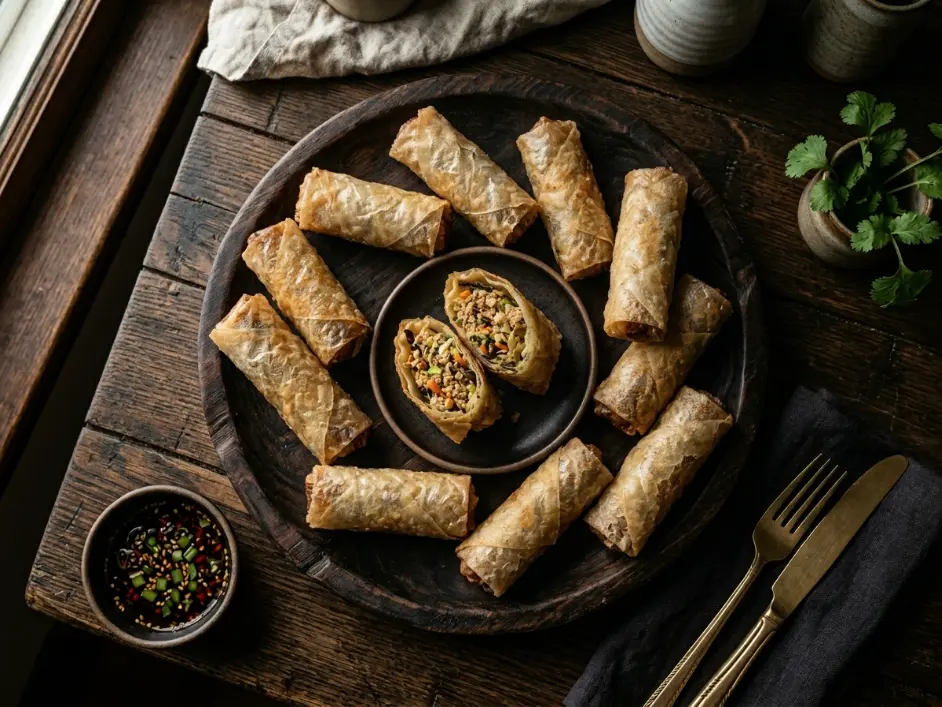
Serve the egg rolls hot, within 10 to 15 minutes of frying, with sweet chili sauce, soy sauce, or Chinese hot mustard for dipping.
Chef Joseph’s Insight
“Cooking is not just chemistry — it is memory made edible. When others gather around a table and tear off that first piece of warm, crunchy bread to plunge it into a bubbling, velvety center, the science fades away and pure connection takes over. The most powerful moves in the kitchen are almost always the quiet ones. The overnight rest. The proper preheat. The two-minute wait before you plate. It is the patience to wring out every last drop of moisture from your greens, and the care you take in picking the right cheese. Take your time, respect the process, and your kitchen will always reward you.”
— Chef Joseph | Expert Palate
When building a complete takeout-inspired meal around these egg rolls, think about balancing crispy, fried elements with bright, acidic dipping sauces and refreshing sides.
6 Culinary Rules for Incredible Pull-Apart Garlic Butter Pizza Sliders
Technical Data & Nutrition Table
Per Serving (1 egg roll):
| Nutrient | Amount |
|---|---|
| Calories | 185 kcal |
| Protein | 11g |
| Total Fat | 9g |
| Saturated Fat | 2g |
| Carbohydrates | 15g |
| Sodium | 340mg |
| Cholesterol | 38mg |
Note: Nutritional values are careful kitchen estimates based on standard ingredient databases and may vary depending on specific brands and preparation methods used.
Food Safety & Thermal Management
Because these egg rolls contain ground pork, proper thermal management is essential. The safe minimum internal holding temperature for any ground meat filling is 165°F / 74°C, which ensures that any potential pathogens are destroyed.
The danger zone for bacterial growth spans 40°F to 140°F / 4°C to 60°C. Cooked egg rolls left at room temperature for more than two hours enter this zone and should be discarded to prevent foodborne illness risk.
Planning larger Asian-inspired buffets or family gatherings centered around fried elements requires checking the hot-holding equipment procedures laid out over at the Food Network. During parties or buffet service, keep fried egg rolls warm in a low oven set to 200°F / 93°C on a wire rack, not directly on a sheet pan, to maintain crispness.
If the egg rolls cool below 140°F / 60°C, either reheat them back above this threshold using an oven or air fryer (never a microwave) or refrigerate any leftovers promptly.
Never leave ground pork compositions sitting at room temperature for extended periods, especially in warm weather or crowded indoor environments where ambient temperatures can climb.
Storage & Reheating Matrix
| Item State | Fridge Storage Limit | Freezer Safety Option | The Absolute Best Reheating Method |
|---|---|---|---|
| Unfried Rolled Egg Rolls (Stored Raw) | 24 hours in airtight container on parchment | Up to 3 months if frozen individually on a tray then transferred to freezer bags; fry directly from frozen, adding 2 extra minutes | Fry directly from refrigerated or frozen state at 350°F, no thawing required; frozen rolls take 7-8 minutes total |
| Fully Fried Cooked Leftovers | 3 days in airtight container in refrigerator | Not recommended due to severe texture degradation upon thawing | Reheat in air fryer at 375°F for 5-6 minutes or in a 400°F convection oven for 8-10 minutes to restore crispness; microwave makes wrappers soft and soggy |
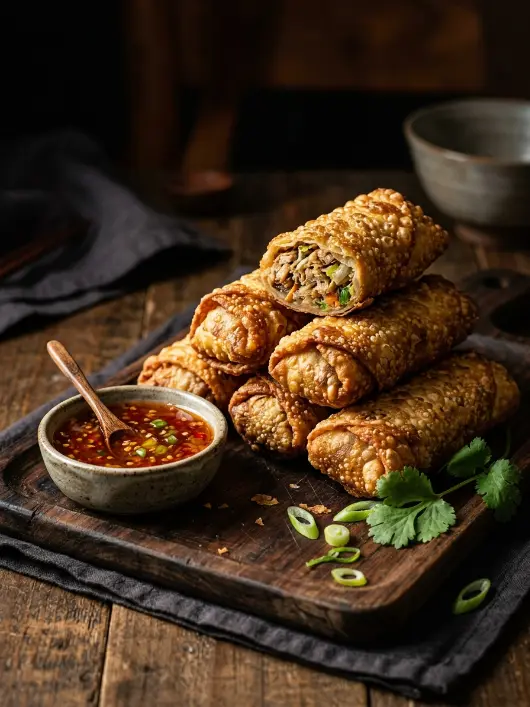
Homemade Crispy Pork and Vegetable Egg Rolls
Ingredients
Equipment
Method
- Shred the fresh green cabbage and julienne the carrots finely, then toss with fine sea salt inside a large bowl to begin osmotic moisture extraction.
- Let the salted vegetables rest at room temperature for fifteen minutes while osmosis draws cellular water to the surface.
- Transfer the vegetables to a fine mesh strainer or wrap tightly in cheesecloth, then squeeze aggressively to extract every drop of hidden vegetable juice.
- Heat a large skillet over high heat and brown the ground pork with minced garlic and ginger, breaking into fine crumbles until fully cooked through.
- Pour the cooked pork mixture into a fine mesh strainer set over a bowl and press firmly to drain off all excess grease and moisture liquid completely.
- Combine the dry squeezed vegetables with the drained meat in a large bowl, then toss gently with soy sauce and toasted sesame oil.
- Let the filling cool to room temperature to prevent condensation from forming inside the wrappers during assembly.
- Lay an egg roll wrapper flat in a diamond shape orientation on a clean dry work surface with one corner pointing toward you.
- Spoon exactly two tablespoons of the cooled dry filling onto the lower center quadrant of the dough diamond sheet, forming a horizontal log.
- Fold the bottom corner up over the filling tightly, then pull in the left and right side corners symmetrically to create an envelope shape.
- Brush the top remaining corner flap lightly with whisked egg wash to serve as a secure protein-based adhesive paste.
- Roll the cylinder forward with steady internal tension, keeping the wrapper taut, until sealed into a tight uniform package structure.
- Heat peanut oil inside a deep heavy pot to exactly 350 degrees Fahrenheit, using a thermometer to maintain consistent temperature.
- Working in small batches of three to four rolls, carefully submerge the egg rolls and fry for five to six minutes, turning continuously.
- Remove using a wire spider spoon when the wrappers reach a rich uniform golden brown color with visible micro-blisters.
- Rest upright or at an angle on a wire cooling rack to shed surface oil without trapping steam that would soften the crisp coating.
- Serve hot within ten to fifteen minutes with sweet chili sauce, soy sauce, or Chinese hot mustard for dipping.
Notes
Frequently Asked Culinary Questions
Can I bake these egg rolls instead of deep-frying them without losing the shattering texture?
You can bake egg rolls at 425°F / 218°C for 20 to 25 minutes, brushing them with oil before baking and flipping halfway through. However, the texture will be fundamentally different—crispy but not shattering, with a drier, bread-like quality rather than the glass-like crunch of deep-fried wrappers. The rapid heat transfer of deep frying creates micro-blisters that baking cannot replicate. For the closest approximation, use an air fryer at 390°F for 12 to 14 minutes.
Why do my egg rolls develop massive, oily blisters that explode open while frying?
This happens when there is residual moisture in the filling or when the oil temperature is too high. Water trapped inside the wrapper flash-converts to steam, creating violent pressure that ruptures the wrapper. Always ensure your filling is completely dry and cooled before wrapping, and maintain oil temperature at a steady 350°F—not higher. If your thermometer reads 375°F or above, the rapid heat creates steam faster than it can escape through natural micro-perforations.
How can I keep the filling completely dry without losing the natural umami pork juices?
The key is distinguishing between flavorful fat-soluble compounds and water-based liquids. The umami compounds in pork are largely fat-soluble, so draining away the rendered fat and cooking liquid does not diminish flavor—it concentrates it. The soy sauce and sesame oil you add after draining reintroduce moisture in controlled, minimal amounts that coat the ingredients without creating free-standing liquid. This gives you maximum flavor with minimum steam risk.
Should I use cornstarch or a whole egg wash paste to securely lock down the wrapper flaps?
Use a lightly whisked whole egg. Cornstarch mixed with water creates a simple starch adhesive that can work, but it is water-based and less reliable under high heat. Whole egg contains proteins that coagulate and denature under heat, creating a permanent, heat-set bond that holds even through vigorous frying. The egg also adds a slight golden color to the seal, which looks more appealing than a pale cornstarch line.