6 Unparalleled Rules to Prevent a Disastrous Dry Tuscan Garlic Butter Pork Loin
The Problem Nobody Talks About
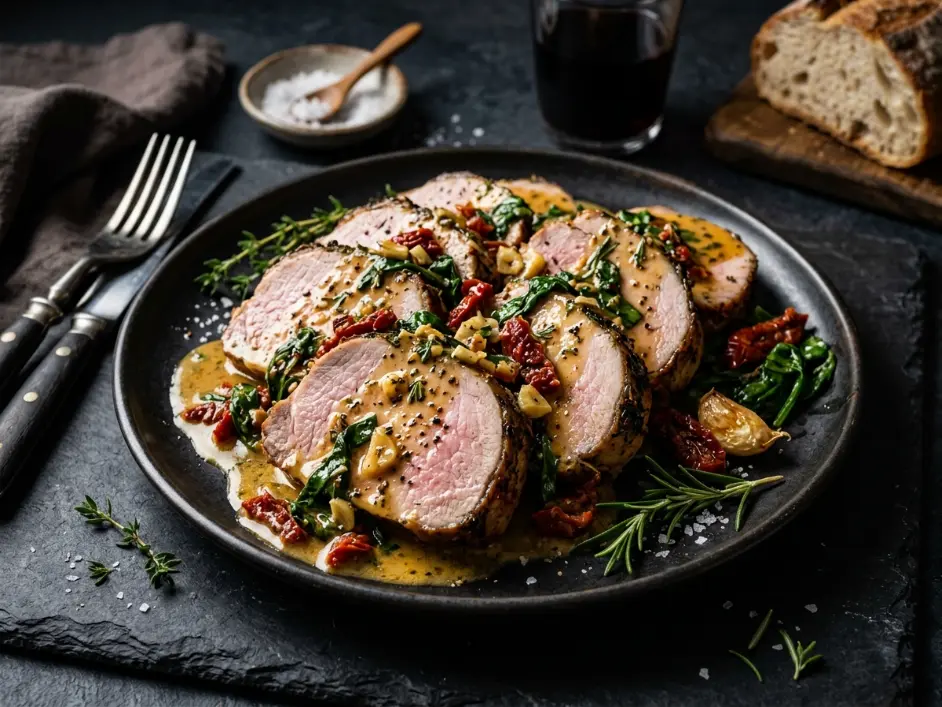
Imagine slicing into a thick, premium center-cut loin that yields effortlessly to reveal a glistening, hyper-juicy core, drenched in a velvety garlic-infused butter emulsion bursting with the savory umami of sun-dried tomatoes and wilted spinach.
Now flip that script. The disastrous kitchen reality hits different: a chalky, gray, shoe-leather slab of overcooked pork swimming in a split pool of greasy oil and watery juices that tastes metallic and dry. The spinach has turned to mush. The garlic bits are burnt black specks. The butter and cream have separated into two disgusting layers.
I have tested this method across dozens of batches in the Expert Palate test kitchen, adjusting one variable at a time to isolate exactly what makes the difference between a split, oily mess and a perfectly bound, velvety emulsion. The gap between catastrophe and excellence isn’t huge—but it is precise.
This is where most home cooks fail with lean pork loin. They follow generic roasting times. They ignore the physics of moisture loss. They add cold cream to screaming-hot pans and wonder why everything breaks apart.
The Tuscan garlic butter pork loin sits in that dangerous middle ground where one misstep—just one—collapses the entire dish into dryness and separation. But nail these six rules, and you’ll own something restaurant-quality sitting in your dining room.
6 Unrivaled Culinary Secrets to Avoid Disastrous Dry Dump-and-Go Crockpot BBQ Pulled Pork Sandwiches
The Thermodynamics of Myofibrillar Coagulation and Lipid Fusing
Here’s what happens inside a pork loin when heat enters the equation. Pork loin is one of the leanest cuts on the animal—almost entirely fast-twitch muscle fibers with minimal intramuscular fat and collagen. That’s actually a liability.
When proteins in muscle tissue reach a certain thermal threshold, their molecular structure tightens. The myofibrillar proteins (the thick and thin filaments that make muscle fibers contract) denature and coagulate. Think of them like tiny sponges wringing themselves dry. Every degree beyond the safe zone pushes more and more intracellular moisture out onto the plate instead of keeping it locked inside the fiber network.
In simple terms: Lean pork loin has almost no fat to absorb that squeezed-out moisture. So the meat becomes porous, hollow, and dry—the opposite of what we want.
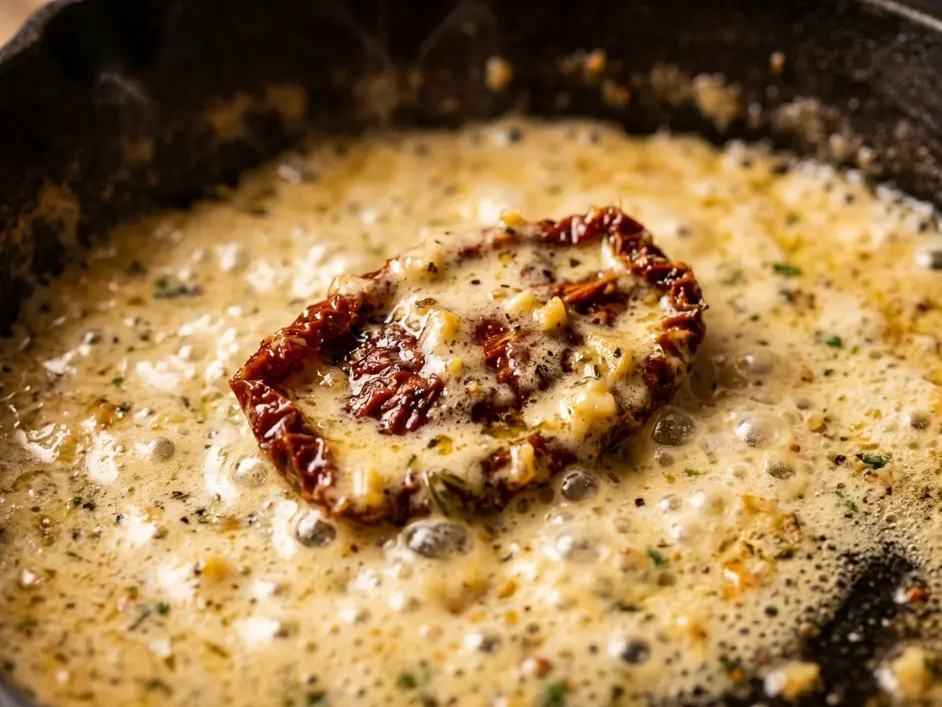
Here’s where the Tuscan emulsion saves you. When you build a heavy cream and butter pan sauce over high heat, something beautiful happens chemically. The rendered pork juices (full of amino acids and gelatin from the pan-fond), the saponified allium lipids from melting garlic in butter, and the milk solids in heavy cream create a colloidal suspension—a stable, clinging liquid that wraps around each slice of pork and reintroduces moisture and richness at the plate.
Rendered Pork Amino Acids+Saponified Allium Lipids+Lactic Acid Proteins→Bound Velvety Tuscan Emulsion
The trick is understanding that this emulsion is fragile. Too much direct heat. Too much acid. Too fast. And the lipids separate from the water-based cream, leaving you with greasy pools and broken sauce.
Pro Sourcing & Ingredient Selection
The first rule starts at the butcher counter. You need a center-cut, bone-in or fat-capped pork loin roast—ideally 3 to 3.5 pounds. That exterior fat cap isn’t decoration. It’s an insulator. It shields the lean lean meat from thermal shock and uneven cooking during the roasting phase.
If your butcher has already trimmed off the fat cap, ask them not to. If they won’t oblige, find another butcher. The fat cap is non-negotiable here.
For the emulsion itself, upgrade your butter. Most supermarket butter is 80% butterfat, 15% water, and 5% milk solids. European-style cultured butter pushes closer to 86% butterfat and has a higher concentration of lactic acid compounds that stabilize cream-based sauces. Hunt it down at specialty Mediterranean delis or upscale grocers. The difference in sauce cling and silkiness is immediate.
Choose dry-packed sun-dried tomatoes over oil-packed varieties. Oil-packed versions are already swimming in oxidized lipids that can muddy the clarity of your pan base. Dry-packed tomatoes let you control the fat content entirely through your butter and cream ratios.
For spinach, fresh organic baby leaves are your only option. Frozen spinach releases too much trapped water when thawed, diluting your sauce consistency. Baby spinach also has a more delicate cell structure, so it wilts into the sauce instead of becoming fibrous.
Heavy whipping cream with zero stabilizers—no guar gum, no carrageenan. These thickening agents can actually prevent proper emulsification because they interfere with the natural protein bonding that holds the sauce together.
Ingredients Table
| Category | Ingredient | US Customary | Metric |
|---|---|---|---|
| The Center-Cut Pork Base | Whole pork loin roast, fat cap intact | 3.5 lbs | 1.59 kg |
| Coarse sea salt | 1.5 tsp | 9g | |
| Freshly cracked black pepper | 1 tsp | 2g | |
| The Searing & Roasting Medium | Avocado oil (high smoke point) | 2 tbsp | 30ml |
| The Tuscan Cream Emulsion | European cultured butter | 4 tbsp | 56g |
| Heavy whipping cream (full fat, no stabilizers) | 0.75 cup | 180ml | |
| Low-sodium chicken stock | 0.5 cup | 120ml | |
| The Botanical Aromatics | Fresh garlic cloves, minced | 8 cloves | 40g |
| Sun-dried tomatoes, julienned | 0.5 cup | 85g | |
| Organic baby spinach, fresh | 3 cups loosely packed | 90g | |
| Fresh thyme sprigs | 4 sprigs | 6g | |
| Fresh rosemary, chopped | 2 tbsp | 12g | |
| The Finishing Cheese | Grana Padano, freshly grated | 0.5 cup | 50g |
Common Kitchen Blunders
| The Kitchen Blunder | What Actually Happens (Scientific Reality) | The Chef Joseph Fix |
|---|---|---|
| Trimming off the exterior fat cap entirely | The lean muscle fibers lose their thermal insulator, causing uneven oven heat penetration. The exposed outer surfaces cook at a different rate than the center, creating a thick band of overdone, dry meat around a potentially undercooked core. | Leave the fat cap intact. It acts as a heat distributor and moisture barrier. If your butcher trimmed it, request it added back or switch sources. |
| Cooking past the 145°F safe target threshold | Every degree past 145°F causes the myofibrillar proteins to tighten further, squeezing out cellular water into the pan. By 160°F, you’ve lost 30-40% of the loin’s original moisture content. The meat becomes porous and hollow. | Pull the roast at 138°F internal temp, tent loosely with foil, and let carryover cooking push it safely to 145°F. A digital instant-read thermometer is non-negotiable. |
| Adding minced garlic to the pan too early at high heat | Garlic contains volatile sulfur compounds (allicin, thiosulfates) that burn instantly at temperatures above 325°F. Burnt garlic turns black, acrid, and bitter—it taints the entire pan sauce with a metallic, scorched flavor that no amount of cream can mask. | Add minced garlic only after you’ve melted the butter and reduced the pan heat to medium. Stir continuously for 45 seconds until fragrant, then immediately add stock and spinach to lower the temperature. |
| Using low-fat milk or half-and-half instead of full-fat cream | Low-fat dairy contains insufficient milk solids (casein proteins) to stabilize an emulsion. The water-based portion separates from the fat under heat, leaving you with a greasy pool and broken, curdled cream streaks floating on top. The sauce looks and tastes broken. | Always use heavy whipping cream (minimum 36% butterfat). The higher fat content provides enough lipids to bind the water phase into a smooth, clingable suspension. |
| Slicing the roast immediately without resting | When the roast exits the oven, internal muscle fibers are still contracting and expelling cellular fluid. If you slice immediately, that pressurized juice floods onto the cutting board instead of staying locked inside the meat fibers. Each slice becomes drier and drier as the juice drains away. | Rest the whole roast under loose foil for 8-10 minutes. This allows internal pressure to equalize and muscle fibers to relax, reabsorbing cellular juices. The meat stays juicy when you finally slice. |
| Heating the pan sauce too aggressively after adding cream | Sustained boiling causes cream proteins to denature and the emulsion to break down. The lipids and water phases separate irreversibly. You end up with a split, greasy sauce that tastes thin and oily instead of velvety and rich. | Bring the pan sauce only to a gentle simmer (small, lazy bubbles) after adding cream. Stir constantly. Once the Grana Padano melts in, reduce to low heat. Never let it boil hard. |
Step-by-Step Method
Step 1: High-Intensity Pan Searing and Crust Formation
Start by patting the whole center-cut pork loin completely dry with paper towels. Moisture on the surface prevents the Maillard browning reaction—the chemical process that creates that deep mahogany crust packed with savory compounds. If the surface is wet, the meat steams instead of sears.
Season all sides generously with coarse sea salt, cracked black pepper, and chopped fresh rosemary. Don’t be shy. The salt triggers enzymatic changes that help the muscle fibers retain moisture during cooking.
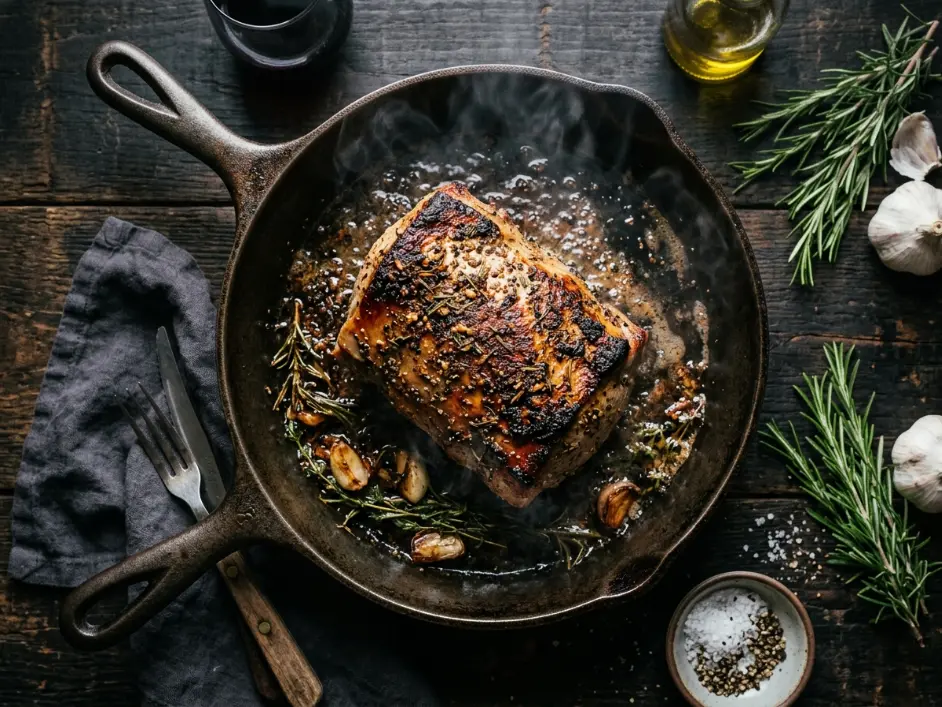
Heat avocado oil in a large heavy cast-iron skillet over high heat until you see thin wisps of smoke rising from the surface. Cast iron retains heat better than any other pan, maintaining that intense searing temperature throughout the browning process.
Place the roast into the smoking-hot oil. You’ll hear an aggressive sizzle—that’s the Maillard reaction beginning. Use stainless steel tongs to rotate the roast every 90 seconds, searing all sides until you develop a uniform mahogany crust across the entire exterior. This takes about 8-10 minutes total. Don’t move the roast constantly. Let each side spend uninterrupted time making contact with the hot pan surface.
Step 2: Precision Thermal Oven Roasting
Transfer the seared roast onto a sheet pan lined with parchment paper. Insert a digital instant-read thermometer probe into the thickest point of the roast, positioning it so the tip reaches the dead center without touching bone (if yours has bone). Slide the pan into an oven preheated to 375°F / 190°C.
Roast undisturbed. Do not open the oven door to peek. That releases precious heat and extends cooking time unevenly. The roast will typically reach your target temperature (138°F / 59°C) in 22-28 minutes, depending on the exact thickness and your oven’s true temperature (invest in an oven thermometer—many ovens run 25°F off).
Here’s the critical move: Pull the roast out when the thermometer reads 138°F, not 145°F. Residual carryover energy will continue cooking the meat for another 5-7 minutes while it rests. That gentle coast brings it to the perfect safe target of 145°F / 63°C without pushing it into dryness.
Step 3: Deglazing and Extracting the Tuscan Fat Matrix
Remove the pork roast to a warm wooden cutting board and tent it loosely with aluminum foil. This keeps the residual heat circulating without trapping steam that would soften the crust.
While the roast rests, place the same hot cast-iron skillet (still full of rendered pork drippings and caramelized browned bits) back over medium-high heat. Melt 4 tablespoons / 56g of European cultured butter directly into those pan drippings, scraping aggressively with a wooden spoon to liberate every stuck caramelized pork fragment. These browned bits—called fond—are pure umami. They’re dissolved proteins and carbohydrates that add incredible savory depth to your sauce.
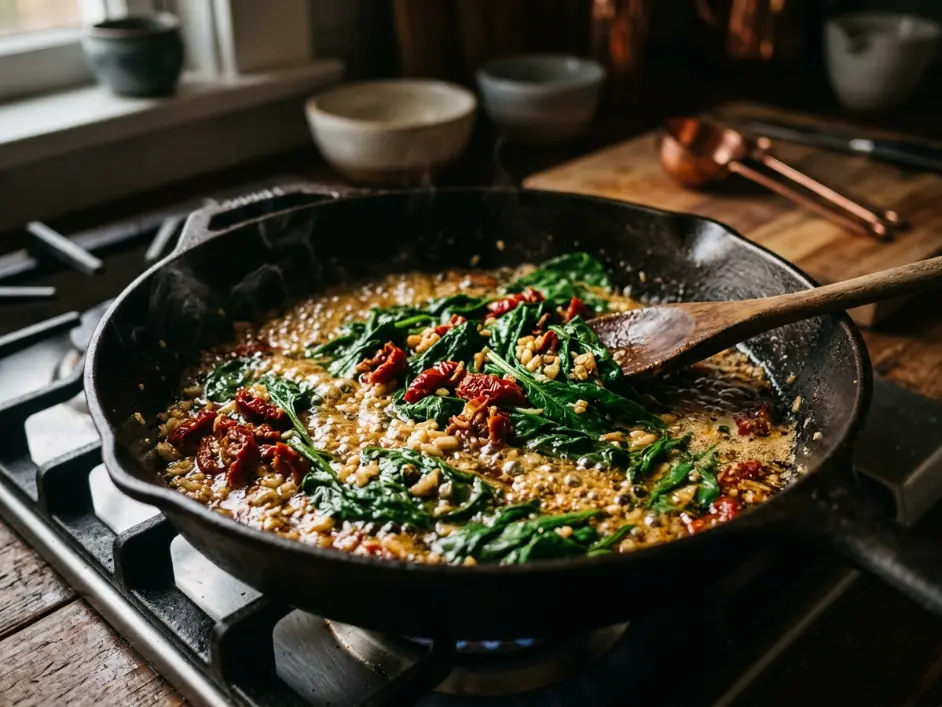
Add 8 minced garlic cloves to the melting butter and stir continuously for 45 seconds, watching carefully until the raw garlic loses its sharp bite and becomes fragrant. The moment you smell that mellow, sweet garlic perfume (roughly 45 seconds), immediately pour in 0.5 cup / 120ml of low-sodium chicken stock and 0.75 cup / 180ml of heavy whipping cream.
Bring the mixture to a gentle simmer—small, lazy bubbles breaking the surface, not a rolling boil. Stir constantly. Add the julienned sun-dried tomatoes and fresh baby spinach, folding gently until the greens wilt completely into the cream. This usually takes 2-3 minutes. The spinach will reduce dramatically—don’t be alarmed. It’s releasing its water content into the sauce, which is exactly what you want.
Step 4: Cream Suspension and Final Glaze Assembly
Reduce the heat to low. Sprinkle in 0.5 cup / 50g of freshly grated Grana Padano cheese, stirring gently until completely melted and incorporated. The milk proteins in the cheese help stabilize the emulsion even further, creating that velvety, cling-to-the-meat texture.
Taste the sauce. Add a pinch more sea salt if needed. The sauce should taste rich, garlicky, creamy, and deeply savory—with subtle umami from the sun-dried tomatoes and a whisper of bitter green from the spinach.
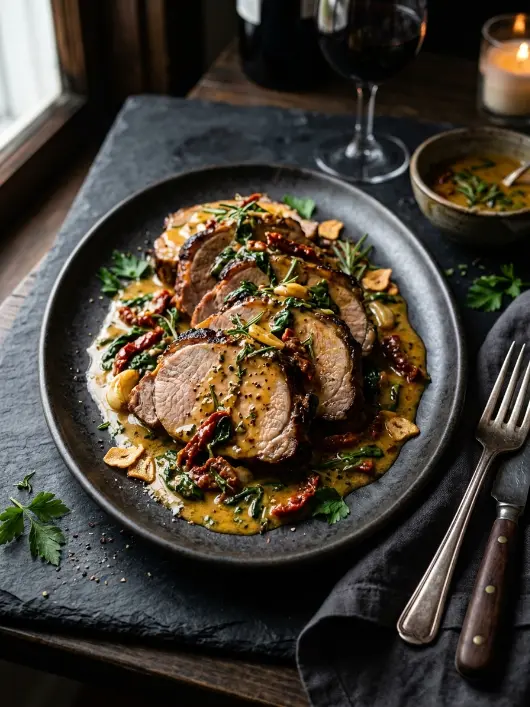
Remove the foil from the resting roast and transfer it to a clean wooden cutting board. Using a sharp serrated knife, slice the roast into 0.75-inch / 2cm thick portions. Arrange the slices on a warm serving platter or individual plates, then ladle the Tuscan cream sauce generously over each piece, making sure every slice gets a portion of the wilted spinach and sun-dried tomato shards.
Cooking is not just chemistry—it is memory made edible. When others gather around a table and tear off that first piece of warm, crunchy bread to plunge it into a bubbling, velvety center, the science fades away and pure connection takes over. The most powerful moves in the kitchen are almost always the quiet ones. The overnight rest. The proper preheat. The two-minute wait before you plate. It is the patience to wring out every last drop of moisture from your greens, and the care you take in picking the right cheese. Take your time, respect the process, and your kitchen will always reward you. — Chef Joseph | Expert Palate
Nutrition Information (Per Serving)
| Nutrient | Amount |
|---|---|
| Calories | 462 kcal |
| Protein | 48g |
| Total Fat | 24g |
| Saturated Fat | 11g |
| Carbohydrates | 8g |
| Sodium | 385mg |
| Cholesterol | 132mg |
Note: Nutrition values are careful kitchen estimates based on standard USDA database ingredient specifications. Actual values may vary slightly depending on specific product brands and exact portion sizes used.
Food Safety & Thermal Management
Pork safety standards have evolved significantly over the past decade. Modern pork production has dramatically reduced trichinella parasite risk, which means you can safely cook pork loin to a lower internal temperature than older guidelines suggested.
The current safe minimum internal temperature for whole pork roasts is 145°F / 63°C, followed by a mandatory 3-minute resting period. At this temperature, any potential pathogens are eliminated, and the meat remains juicy and tender.
The critical danger zone for bacterial growth occurs between 40°F / 4°C and 140°F / 60°C. Never leave your prepared pork roast sitting at room temperature for more than 2 hours before cooking begins. Once the roast reaches 140°F during cooking, it must reach 145°F within 4 hours to remain safe.
When measuring internal temperature, insert your digital probe thermometer into the thickest part of the roast without touching bone or pan surface. Let the probe sit for 3 seconds before reading. Take multiple measurements at different points if the roast is particularly thick—the thickest point is your safety baseline.
Note that managing safe internal temperatures and sanitary protein slicing boundaries during hot dinner hosting setups lines up perfectly with the safety protocols maintained over at the Food Network. For deeper thermal safety reference data, FoodData Central provides comprehensive ingredient composition standards.
Storage & Reheating Matrix
| Storage State | Fridge Limit | Freezer Option | Best Reheating Method |
|---|---|---|---|
| Sliced pork loin fully enrobed in Tuscan cream sauce | 3-4 days in airtight container | Up to 3 months in vacuum-sealed bag | Gentle oven reheat at 325°F / 163°C covered with foil, approximately 15-18 minutes. The low heat prevents cream lipids from separating. Alternatively, reheat gently in a covered skillet over low-medium heat with 2 tablespoons of bone broth added to prevent sauce reduction. |
| Isolated leftover Tuscan garlic butter pan base (sauce only) | 3 days covered | Up to 2 months in ice cube trays for portion control | Thaw overnight in fridge. Gently reheat in a saucepan over low heat, stirring frequently. Add 1-2 tablespoons heavy cream if the sauce has thickened or the lipids have begun separating. Never microwave cream sauces—direct radiant heat causes irreversible emulsion breakdown. |
| Raw pork loin roast (uncooked, unseasoned) | Not recommended—cook immediately | Up to 4 months in vacuum seal | Thaw in refrigerator (never at room temperature). Cook using the same searing and roasting method detailed above. |
Tuscan Garlic Butter Pork Loin
Ingredients
Equipment
Method
- Pat pork loin dry completely. Season all sides with salt, pepper, rosemary. Heat avocado oil in cast iron until smoking. Sear roast all sides 8-10 minutes until mahogany crust forms. Transfer to sheet pan with thermometer inserted into thickest point. Roast at 375°F / 190°C until internal temp reaches 138°F / 59°C (22-28 minutes). Remove and tent loosely with foil to rest 8-10 minutes (carryover cooking brings it to safe 145°F). Return hot cast iron skillet to medium-high heat with all pork drippings and fond. Melt cultured butter while scraping up browned bits. Add minced garlic, stir 45 seconds until fragrant. Pour in chicken stock and heavy cream, bring to gentle simmer. Fold in sun-dried tomatoes and fresh spinach, stir until spinach wilts (2-3 minutes). Reduce heat to low, sprinkle Grana Padano cheese, stir until melted and smooth. Taste and adjust salt. Slice rested roast into 0.75-inch / 2cm thick slices. Plate and ladle warm Tuscan sauce over each slice with spinach and tomato shards. Serve immediately.
Notes
Frequently Asked Culinary Questions
Why did my pork loin turn out dry and rubbery even though I followed the timing?
The most common culprit is an inaccurate oven temperature. Many home ovens run 15-25°F hotter or cooler than their dials suggest. Invest in an oven thermometer and verify your actual cooking temperature before you start. The second issue is pulling the roast too late. If you wait for the internal temp to reach 145°F while still in the oven, carryover cooking will push it to 150-155°F—dry territory. Pull at 138°F and let carryover do the work.
How do I keep the heavy cream from separating or curdling when making the Tuscan sauce?
Three rules: First, never add cold cream directly to a screaming-hot pan. Reduce the heat to medium before cream enters. Second, stir constantly while the cream simmers—this distributes heat evenly and prevents hot spots that cause curdling. Third, never let the sauce boil hard. A gentle simmer (small, lazy bubbles) is all you need. If your sauce does break, whisk in an additional tablespoon of cold heavy cream while whisking off-heat to re-emulsify the lipids.
Can I make this Tuscan garlic butter recipe using boneless pork chops instead of a full loin?
Technically yes, but the cooking method changes entirely. Pork chops cook through in 10-12 minutes rather than 25 minutes, so you can’t use the same searing-plus-roasting technique. Instead, sear the chops 4 minutes per side in the cast-iron skillet, then remove them and build the sauce in the same pan. Return the chops for 2-3 minutes at the end to warm them through. The result works, but the even heat distribution of a whole roast produces more consistent doneness.
What is the best way to clean sun-dried tomatoes so they aren’t too chewy in the pan?
Dry-packed sun-dried tomatoes benefit from a quick 2-minute soak in warm water before using. This rehydrates them slightly and makes the texture tender without turning them into mush. Pat them dry afterward and julienne them into thin strips. If they still feel tough after soaking, pass them briefly through a food processor with a drizzle of olive oil to break down the cell walls slightly.
Can I prep the pork loin ahead of time, or does it need to be cooked fresh?
You can season and refrigerate the raw roast up to 24 hours ahead. Keep it loosely covered with plastic wrap so the exterior can develop a subtle pellicle (a thin, dry layer) that actually helps browning. Remove the roast from the fridge 30 minutes before cooking to bring it closer to room temperature—this promotes more even internal cooking. The Tuscan sauce is best made fresh, but you can make it up to 4 hours ahead and store it covered in the fridge. Reheat gently before service.