The Ultra-Brief Thermal Window That Saves 20-Minute Garlic Butter Shrimp and Broccoli Sauté From Structural Ruin
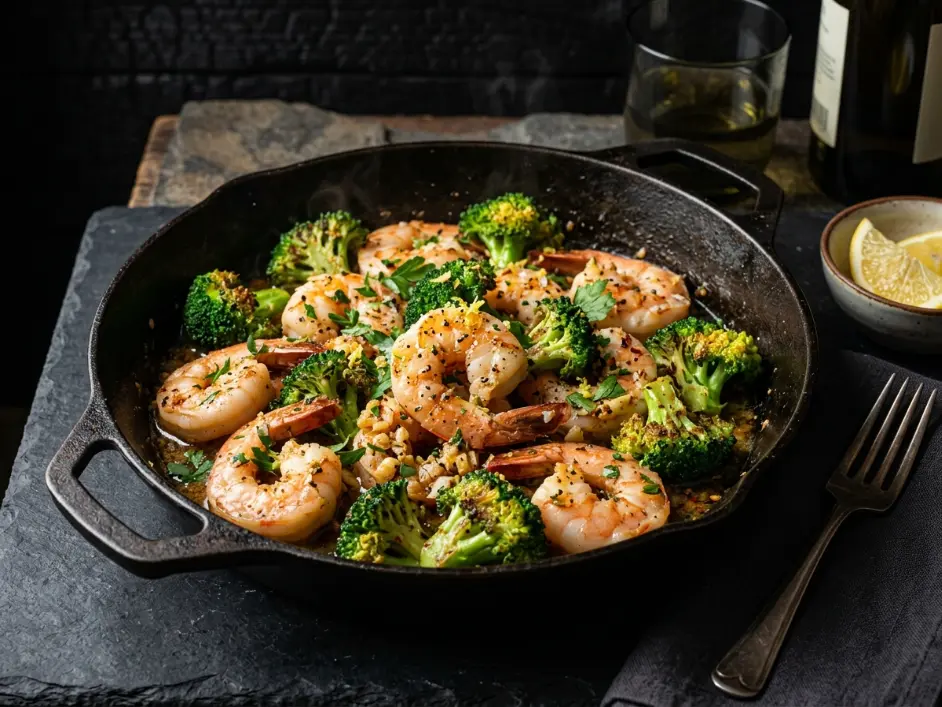
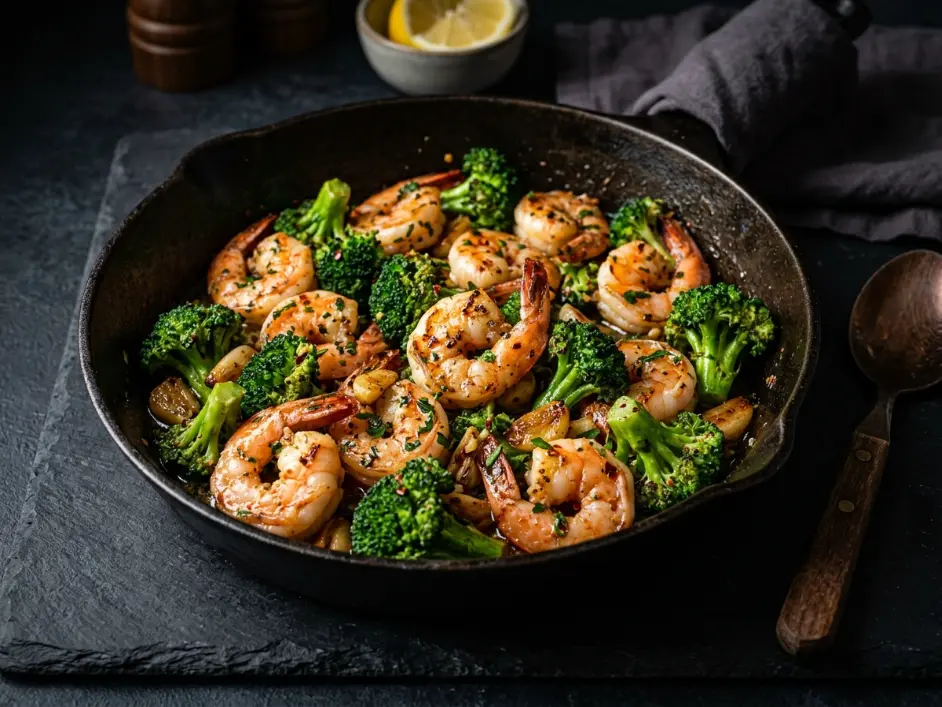
Imagine biting into a succulent pink shrimp that yields instantly to your teeth, releasing sweet briny juices infused with the deep umami of garlic and the rich, velvety coating of brown butter. The broccoli florets are vibrant emerald green, tender-crisp with a structure that snaps slightly when you bite, not mushy or waterlogged. The pan sauce is a glossy, unified emulsion of rendered butter, garlic aromatics, and shrimp juices—silky smooth and clinging to every surface instead of pooling as separated grease.
Now flip that script. The disastrous reality: rubber-hard shrimp curled into dense balls with the texture of pencil erasers. The broccoli has turned to gray-green mush, its chlorophyll destroyed by excessive heat and steam. The butter sauce has separated into greasy oil floating on watery liquid. The garlic is burnt black and tastes acrid. The whole 20-minute garlic butter shrimp and broccoli sauté tastes like a kitchen failure instead of a restaurant-quality weeknight dinner.
I have tested this method across dozens of batches in the Expert Palate test kitchen, adjusting one variable at a time to isolate exactly what makes the difference between a split, oily mess and a perfectly bound, velvety emulsion. The shrimp cooking window is brutally narrow—the difference between perfect and rubbery is literally 30-45 seconds of cooking time.
This is where most home cooks catastrophically fail. They overcook the shrimp. They steam the broccoli instead of sautéing it. They burn the garlic. One misstep and your dish becomes a textural disaster.
But master this thermal window, and you’ll own a weeknight meal that tastes like you spent hours perfecting technique instead of exactly twenty minutes in your kitchen.
5 Unrivaled Skillet Laws to Avoid Disastrous Broken One-Skillet Creamy Cajun Chicken Pasta
The Biochemistry of Myosin Denaturation and Lipid-Water Emulsion Stabilization
Here’s the precise molecular reality happening in your skillet when you cook shrimp and broccoli correctly. Shrimp is approximately 75% water, 20% protein (predominantly myosin and actin), and 5% fat. The entire dish depends on controlling protein denaturation timing and lipid emulsion stability.
When heat enters the system, shrimp myosin proteins begin unraveling at around 140°F / 60°C. This protein denaturation is essential—it transforms the raw translucent shrimp into cooked opaque pink. But here’s the trap: if you exceed 145°F / 63°C, the myosin proteins denature completely and squeeze out their bound water molecules into the pan as liquid.
In simple terms: Undercooked shrimp is mushy and translucent. Perfectly cooked shrimp is tender and opaque pink. Overcooked shrimp is rubbery and dense because all the water has been wrung out and the proteins have contracted excessively.
The thermal window is insanely narrow. You have roughly 45-60 seconds between “perfect” and “rubbery” when cooking thin shrimp at high heat. This is why precision matters obsessively. You’re racing against a molecular clock.
The broccoli component adds complexity. Broccoli florets contain chlorophyll—the green pigment that makes them vibrant. Chlorophyll is acid-sensitive. When you heat broccoli in the presence of acid (the acids in shrimp juices and in garlic’s sulfur compounds), the chlorophyll breaks down and converts to pheophytin, a dull olive-gray pigment. Simultaneously, prolonged heat causes chlorophyll to degrade into brown compounds.
This is why traditional boiled broccoli turns gray-green—the moisture traps acids against the chlorophyll molecules, accelerating degradation. Conversely, a rapid sauté with minimal liquid exposure preserves chlorophyll structure.
The garlic factor is equally critical. Fresh garlic contains allicin—a volatile sulfur compound with massive aromatic and flavor potential. When you heat garlic at high temperature, allicin breaks down into smaller, more pungent compounds. The flavor deepens and becomes mellow. But if garlic exceeds about 300°F / 149°C, it burns and converts into bitter, acrid compounds that taste metallic and unpleasant.
The butter emulsion is where everything ties together. When you add cold butter to a hot, liquid-filled pan, you’re creating an emulsion—a suspension of fat droplets in water. Butter is about 80% fat, 15% water, and 5% milk solids. The water evaporates quickly, leaving behind the fat and milk solids that form a stable emulsion coating the shrimp and broccoli.
But this emulsion is fragile. Too much heat causes the fat and water to separate irreversibly. Too much agitation breaks the emulsion. The right temperature (around 180-200°F / 82-93°C after adding butter) allows the emulsion to stabilize and cling to everything.
Myosin Proteins+Controlled Heat+Rapid Evaporation→Tender Succulent Shrimp
Analyzing the raw structural properties, cellular lipid densities, and nutrient profiles of raw shrimp scales accurately by checking verified biochemical datasets from the global FoodData Central database. Raw shrimp typically contains approximately 0.3g fat per 100g and about 24g protein per 100g, with specific myosin isoforms that denature at precise temperature thresholds varying by shrimp species and size.
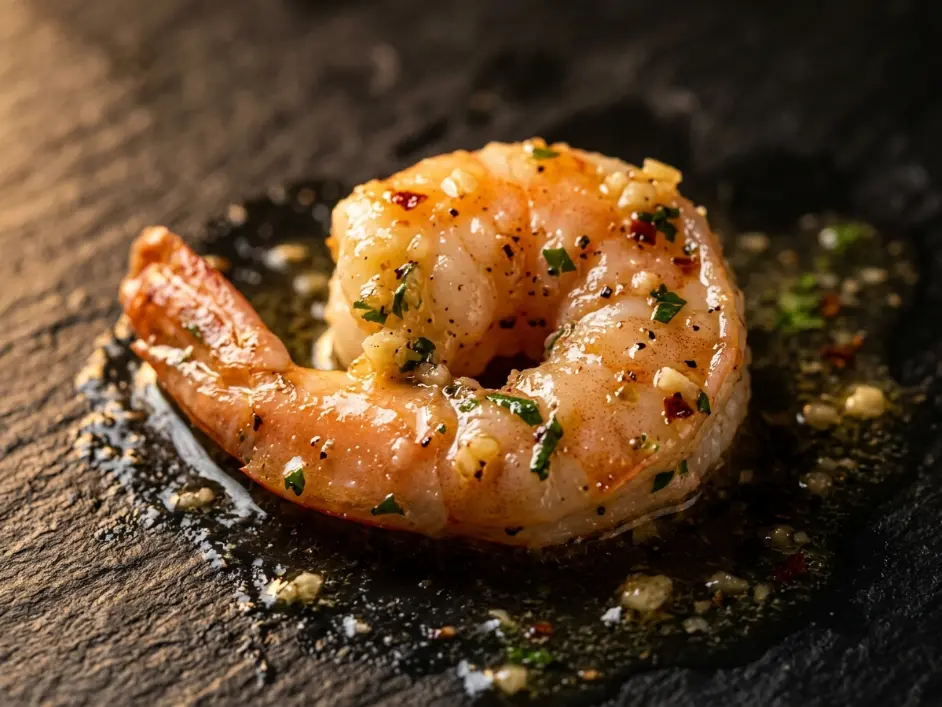
Pro Sourcing & Ingredient Selection
Start with shrimp sizing. Look for U-15/U-20 shrimp (meaning 15-20 individual shrimp per pound). These larger shrimp cook more evenly than tiny U-30/U-40 varieties. The larger cross-section means the exterior and interior reach target temperature simultaneously. Avoid frozen shrimp that’s been thawed—the thawing process compromises the myofibrillar protein structure, resulting in mushy cooked texture. Buy fresh wild-caught Gulf shrimp if available—they have firmer texture and superior flavor compared to farmed varieties from Southeast Asia.
For broccoli, look for tight, compact crowns with deep emerald-green color. Avoid florets with yellowing or browning edges—that indicates age and oxidation. Fresh broccoli should feel heavy for its size and have a slight sweetness when snapped fresh. Pre-cut florets sitting in plastic containers have already begun oxidizing—buy whole heads and cut them yourself for optimal texture and color preservation.
For butter, use European-style cultured butter with higher butterfat content (86-88% vs. standard 80%). The higher fat percentage creates a richer emulsion and tastes infinitely more luxurious. Cold-pressed extra virgin olive oil is optional but transforms the dish—it adds fruity, peppery aromatics that deepen when mixed with garlic and shrimp juices.
For garlic, use fresh whole cloves—not pre-minced garlic from a jar. Fresh garlic has volatile sulfur compounds that are vibrant and aromatic. Pre-minced garlic has already begun oxidizing, losing aromatic potency and developing sulfur flavors that taste stale and hollow.
Comprehensive Ingredients Table
| Category | Ingredient | US Customary | Metric |
|---|---|---|---|
| Marine Protein Component | Fresh U-15/U-20 wild-caught shrimp (peeled, deveined) | 1.25 lbs | 568g |
| Cruciferous Vegetable Base | Fresh broccoli florets (tight, compact crowns) | 1.5 lbs | 680g |
| Lipidic Emulsion Aromatics | European-style cultured butter (high butterfat) | 4 tbsp | 56g |
| Fresh garlic cloves (whole, minced just before cooking) | 6 cloves | 30g | |
| Coarse sea salt | 1 tsp | 6g | |
| Freshly cracked black pepper | 0.5 tsp | 1g | |
| Red pepper flakes (optional heat) | 0.25 tsp | 0.5g | |
| Finishing & Brightness | Fresh lemon juice (freshly squeezed) | 2 tbsp | 30ml |
| Lemon zest (finely grated) | 1 tbsp | 6g | |
| High-smoke-point cooking oil (avocado or refined coconut) | 2 tbsp | 30ml | |
| Fresh parsley (coarsely chopped, for garnish) | 0.25 cup | 15g | |
| Grated Parmesan cheese (optional finishing) | 0.25 cup | 25g |
Common Kitchen Blunders Matrix
| The Kitchen Blunder | What Actually Happens (Scientific Reality) | The Chef Joseph Fix |
|---|---|---|
| Overcooking the shrimp by more than 45-60 seconds | Myosin and actin proteins denature completely and contract excessively, squeezing out all bound intracellular water into the pan. The shrimp becomes dense, rubbery, and unappealing—the texture transforms from tender to eraserlike. The shrimp also loses its characteristic sweet briny flavor because the water molecules that carry flavor compounds have been expelled from the protein structure. | Cook shrimp at high heat until the surface just turns opaque pink and the flesh begins curving slightly—typically 2-3 minutes for U-15/U-20 size. Resist the urge to cook longer. The shrimp will continue cooking slightly from residual heat after you plate. Start checking at 90 seconds if your heat is particularly high. |
| Steaming the broccoli instead of sautéing | Prolonged contact with steam and moisture causes chlorophyll degradation and acid-catalyzed color loss. The broccoli transforms from vibrant green to dull olive-gray. Additionally, steam creates a waterlogged texture that’s mushy and lacks structural integrity. The broccoli essentially stews in its own released water instead of maintaining its cellular structure through rapid, dry-heat sautéing. | Par-blanch the broccoli for exactly 2 minutes in rapidly boiling salted water, then ice-bath it immediately to halt cooking. This pre-cooking removes surface water without destroying chlorophyll. When you add it to the hot skillet, it finishes cooking in seconds via dry sauté, not steam, preserving both color and texture. |
| Adding garlic at the beginning and letting it cook too long | Fresh garlic allicin compounds break down under sustained high heat above 280°F / 138°C. After about 60-90 seconds at high heat, the aromatic compounds convert into bitter, pungent sulfur compounds that taste acrid and metallic instead of sweet and mellow. You lose the delicate garlic flavor and end up with harsh, burnt-tasting notes that dominate the dish. | Add minced fresh garlic only after you’ve seared the shrimp and they’re nearly done. This timing ensures the garlic heats for just 30-45 seconds—long enough to release aromatic allicin compounds and deepen flavor, but not long enough to burn. The residual heat and shrimp juices create the perfect garlic infusion window. |
| Adding butter to a boiling-hot pan without removing from heat | When cold butter contacts a pan above 212°F / 100°C, the water content in the butter flashes to steam violently, shattering the emulsion structure before it can form. The milk solids separate from the fat, and the fat oxidizes rapidly from the intense heat. You end up with a broken, separated sauce that tastes burnt and oily instead of silky and cohesive. | Reduce the heat to low immediately before adding the cold butter. Stir the butter gently as it melts into the pan, allowing the water to evaporate slowly and the emulsion to stabilize gradually. This gentle approach creates a glossy, unified sauce that clings to everything instead of separating into grease pools. |
| Using pre-cut frozen shrimp thawed in advance | The freezing process creates ice crystals inside shrimp cells that rupture the myofibrillar protein structure during thawing. When you cook thawed shrimp, the compromised protein structure can’t retain water effectively—the shrimp releases excess liquid and becomes mushy and watery instead of tender and firm. The texture is fundamentally compromised before cooking even begins. | Always buy fresh shrimp or frozen shrimp that you thaw immediately before cooking (in a bowl under cold running water for 5-10 minutes). Never thaw frozen shrimp in advance or store it thawed. The moment you’re ready to cook, you should be cooking. Fresh shrimp cooked immediately delivers superior, predictable texture. |
| Crowding the skillet with too much broccoli and shrimp | Crowding reduces the surface-area-to-heat contact ratio. Instead of sautéing, the ingredients stew in their own released moisture. The shrimp releases water that accumulates in the pan, steaming the ingredients instead of searing them. You lose the Maillard browning reaction on broccoli florets and the shrimp texture suffers from prolonged moisture exposure. The entire dish becomes soggy and mushy. | Leave at least 0.5 inch / 1.3cm of space visible on the pan bottom between pieces. If necessary, cook the broccoli and shrimp in two batches instead of crowding a single pan. Single-layer arrangement ensures high heat makes direct contact with ingredients, creating proper sauté texture instead of steaming. Quality over volume. |
Master Step-by-Step Method
Par-Blanching and Surface Preparation Phase
Begin by bringing a large pot of salted water (approximately 2 quarts / 1.9 liters with 1 tablespoon / 18g coarse sea salt) to a rolling boil. The salt is essential—it seasons the broccoli from inside out and helps preserve chlorophyll color by buffering acids.
Cut your fresh broccoli crowns into uniform florets approximately 2 inches / 5cm in length. Uniform sizing ensures even cooking. Larger crowns take longer to reach tender-crisp texture while smaller florets overcook and turn mushy.
Submerge the broccoli florets into the boiling salted water for exactly 2 minutes. This brief par-blanch removes surface water that would otherwise steam and degrade chlorophyll during the subsequent sauté phase. Two minutes is precise—any longer and the broccoli begins losing structural firmness.
Strain the broccoli through a colander and immediately transfer it to a bowl of ice water. The ice bath halts all cooking instantly by dropping the internal temperature back to nearly 32°F / 0°C. This “shocking” preserves the vibrant green color and maintains cellular structure. Let the broccoli sit in ice water for 30 seconds, then drain thoroughly and pat dry with paper towels. Moisture on the surface would create steam in the skillet.
Pat your fresh shrimp completely dry with paper towels as well. Any moisture on the shrimp surface prevents the high-heat sear from occurring and instead creates steam. Dry shrimp sears. Wet shrimp steams. This distinction is fundamental.
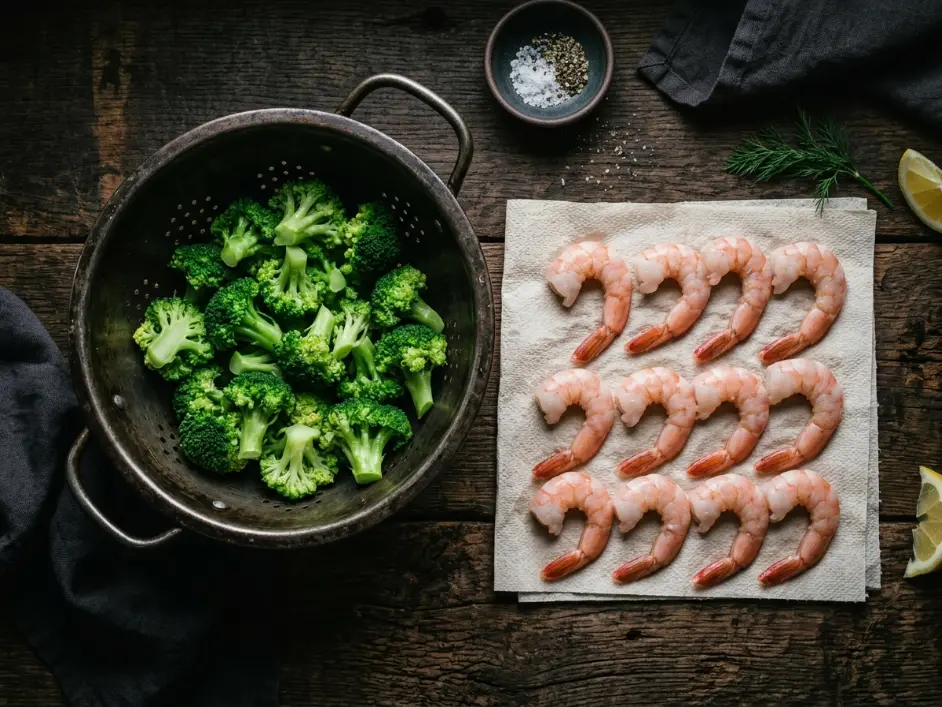
High-Surface Sauté Sear Phase
Heat a large skillet (ideally cast-iron or heavy stainless steel) over high heat for 2-3 minutes until the surface is screaming hot. You want the temperature to reach approximately 400-425°F / 204-218°C. To verify temperature, flick a water droplet onto the surface—it should evaporate instantly with an aggressive sizzle.
Add 2 tablespoons / 30ml of high-smoke-point oil to the hot skillet and swirl immediately to coat the bottom. The oil creates a conductive medium between the heat source and your ingredients. Let the oil heat for 15 seconds until it shimmers visibly.
Add the par-blanched broccoli florets to the skillet in a single layer with visible gaps between pieces. The high heat will immediately begin browning the florets through the Maillard reaction. Resist the urge to stir constantly—let each floret maintain contact with the hot skillet surface for 30-45 seconds before stirring. This contact time is what creates the golden-brown caramelization.
After 2 minutes of sautéing (stirring occasionally to ensure even browning), push the broccoli to the sides of the skillet, creating a clear center space. Add the dried shrimp to this hot center space immediately. Do not stir the shrimp yet—let them sit undisturbed for 90 seconds on their first side. This brief contact creates a light golden-brown sear on the shrimp exterior.
Flip the shrimp and cook the second side for 45-60 seconds. The shrimp will begin curving slightly and the flesh will turn opaque pink. The thermal window is closing—you’re approaching the perfect doneness threshold.
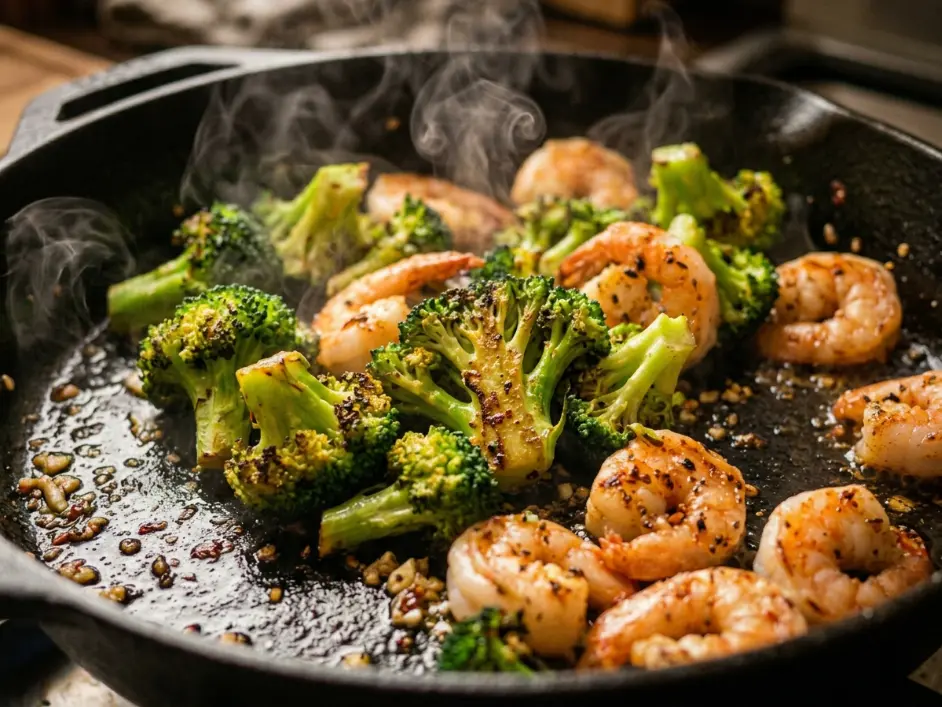
Compound Butter Liaison and Finishing Phase
The moment the shrimp reaches opaque pink color on both sides, reduce the heat to low. This temperature reduction is absolutely critical—you’re preventing the butter from shattering and the emulsion from breaking when you add it.
Add 4 tablespoons / 56g of cold European-style cultured butter to the hot skillet. The butter will sizzle and begin melting immediately. Stir gently as the butter melts, allowing the water content to evaporate slowly and the milk solids to emulsify with the pan juices and rendered shrimp fat. This gentle stirring creates the emulsion—the glossy coating that will cling to the broccoli and shrimp.
Immediately add your 6 minced fresh garlic cloves. The reduced heat and the presence of butter create the perfect environment for garlic to infuse its aromatic allicin compounds without burning. Stir constantly for 30-45 seconds. The kitchen will suddenly fill with the unmistakable aroma of mellow, caramelized garlic—that’s your signal that the flavor infusion is perfect.
Taste the pan sauce and add coarse sea salt, cracked black pepper, and red pepper flakes (if desired). Squeeze in 2 tablespoons / 30ml of fresh lemon juice and add 1 tablespoon / 6g of lemon zest. The acidity brightens the entire dish and adds complexity to the emulsion.
Toss the broccoli and shrimp gently in the butter emulsion, coating everything uniformly. The glossy, unified sauce should cling to every surface, not pool as separated grease at the bottom.
Transfer to serving plates immediately and garnish with fresh coarsely chopped parsley and optional grated Parmesan cheese. The entire cooking process from start to finish takes exactly 20 minutes. Serve immediately while the emulsion remains stable and the shrimp is still warm.
Advanced texture-building techniques thoroughly mapped out over at Serious Eats prove why precision timing and surface management loops ensure absolute success in high-heat seafood cooking.
Cooking is not just chemistry — it is memory made edible. When others gather around a table and tear off that first piece of warm, crunchy bread to plunge it into a bubbling, velvety center, the science fades away and pure connection takes over. The most powerful moves in the kitchen are almost always the quiet ones. The overnight rest. The proper preheat. The two-minute wait before you plate. It is the patience to wring out every last drop of moisture from your greens, and the care you take in picking the right cheese. Take your time, respect the process, and your kitchen will always reward you. — Chef Joseph | Expert Palate
3 Unrivaled Secrets to Prevent Disastrous Greasy Easy Smashed Burger Tacos with Secret Sauce
Technical Data & Nutrition Table
| Nutrient | Per Serving (Approximately 1.5 cups / 355ml) |
|---|---|
| Calories | 245 kcal |
| Protein | 32g |
| Total Fat | 11g |
| Saturated Fat | 5g |
| Carbohydrates | 8g |
| Dietary Fiber | 2g |
| Sodium | 385mg |
| Cholesterol | 195mg |
Note: Nutrition values are careful kitchen estimates based on standard ingredient composition databases. Actual values may vary depending on specific product brands, exact portion sizes used, and how much emulsion clings to each serving.
Food Safety & Thermal Management
Shrimp requires reaching a safe internal structure temperature where myosin proteins have denatured completely, typically around 145∘F/63∘C. At this temperature, the shrimp exterior is opaque pink and the internal structure has solidified. Visual doneness cues (opaque pink color, slight curving) are highly reliable indicators that food-safety thresholds have been met.
The standard danger zone for bacterial growth in seafood occurs between 40∘F−140∘F/4∘C−60∘C. Never leave your prepared 20-minute garlic butter shrimp and broccoli sauté sitting at room temperature for more than 1 hour. Once cooked and the shrimp reaches 145∘F/63∘C, it must remain above 140∘F/60∘C during storage or service.
Executing large-batch seafood spreads safely for hot gatherings or buffet lines requires adhering to the safe holding parameters curated over at the Food Network. For hot holding, keep finished shrimp and broccoli on a warming tray at 140−150∘F/60−65∘C for no longer than 2 hours. Beyond this time window, the butter emulsion begins separating and the shrimp continues cooking internally, becoming rubbery.
Storage & Reheating Matrix
| Storage State | Fridge Limit | Freezer Option | Best Reheating Method |
|---|---|---|---|
| Fully Cooked Shrimp and Broccoli with Butter Emulsion Sauce | 2-3 days in airtight container | Up to 2 months in freezer-safe container, though texture quality degrades. The emulsion separates upon thawing and the shrimp becomes slightly rubbery. | Reheat gently in a skillet over low-medium heat with 2-3 tablespoons of water or chicken broth for 3-4 minutes, stirring occasionally. The gentle heat and added liquid help re-emulsify the butter coating without breaking it further. Alternatively, cover a plate with damp paper towel, place the shrimp and broccoli on top, and microwave gently (30% power) for 1-2 minutes. Never use full microwave power—intense radiant heat shatters the emulsion and turns shrimp rubbery. |
| Cooked Shrimp Only (Without Broccoli or Sauce) | 2-3 days in airtight container | Up to 3 months in vacuum-sealed bag | Reheat in a skillet over very low heat for 1-2 minutes with a tiny splash of water. Watch carefully—reheated shrimp can overcook quickly. Alternatively, incorporate into other dishes like pasta or salads where additional moisture masks any texture degradation. |
| Broccoli Only (Without Shrimp or Sauce) | 3-4 days in airtight container | Up to 3 months in freezer | Reheat gently in a skillet over medium heat for 2-3 minutes. The broccoli tolerates reheating better than shrimp. You can also consume cold directly from the refrigerator as a salad component or snack. |
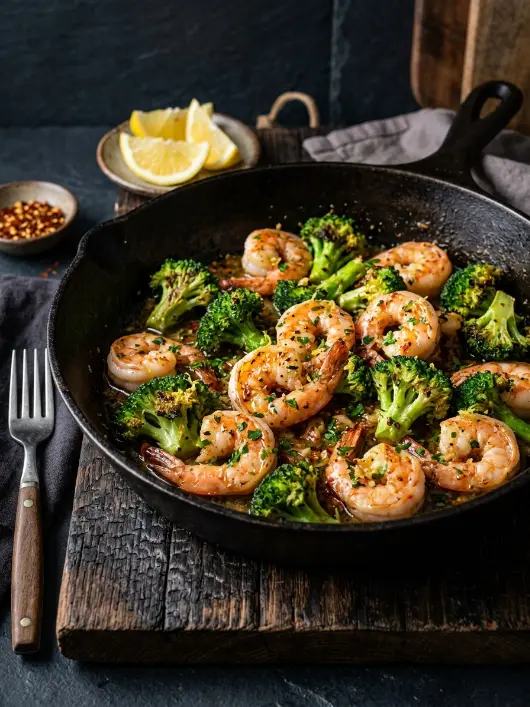
20-Minute Garlic Butter Shrimp and Broccoli Saute
Ingredients
Equipment
Method
- Bring large pot of salted water approximately two quarts with one tablespoon coarse sea salt to rolling boil for par-blanching broccoli.
- Cut fresh broccoli crowns into uniform florets approximately two inches in length ensuring even cooking across all pieces.
- Submerge broccoli florets into boiling salted water for exactly two minutes to remove surface moisture and preserve chlorophyll color through brief thermal treatment.
- Strain broccoli through colander immediately and transfer to bowl of ice water to halt all cooking through rapid temperature reduction and preserve vibrant green color.
- Let broccoli sit in ice water for thirty seconds then drain thoroughly and pat completely dry with paper towels removing all surface moisture that would create steam during sauté.
- Pat fresh U-15/U-20 shrimp completely dry with paper towels ensuring no surface moisture remains to allow proper searing at high heat.
- Heat large cast-iron skillet over high heat for two to three minutes until surface reaches approximately four hundred to four hundred twenty five degrees Fahrenheit for optimal searing.
- Add two tablespoons high-smoke-point oil to hot skillet and swirl immediately to coat bottom uniformly then let oil heat for fifteen seconds until shimmering visibly.
- Add par-blanched broccoli florets to skillet in single layer with visible gaps between pieces allowing high heat direct contact for Maillard browning reaction.
- Allow broccoli to maintain contact with hot skillet surface for thirty to forty five seconds before stirring to develop golden-brown caramelization on all exposed surfaces.
- After two minutes total sautéing time with occasional stirring push broccoli to sides of skillet creating clear center space for shrimp addition.
- Add patted-dry shrimp to hot center space and let sit undisturbed for exactly ninety seconds per side allowing opaque pink color to develop through controlled myosin protein denaturation.
- Flip shrimp and cook second side for forty five to sixty seconds until opaque pink color indicates perfect doneness threshold within narrow thermal window.
- Reduce heat to low immediately to prevent butter emulsion from breaking when cold butter is added to hot pan.
- Add cold European-style cultured butter to hot low-heat skillet and stir gently as it melts allowing water to evaporate slowly and milk solids to emulsify with pan juices.
- Add minced fresh garlic immediately and stir constantly for thirty to forty five seconds until aromatic allowing allicin compounds to infuse without burning.
- Squeeze fresh lemon juice into skillet and add grated lemon zest stirring gently to incorporate acidity and brightness into unified butter emulsion.
- Taste finished sauce and season as needed with additional coarse sea salt cracked black pepper or red pepper flakes for desired flavor profile.
- Toss broccoli and shrimp gently in butter emulsion ensuring all surfaces coat uniformly with glossy unified sauce instead of separated grease pools.
- Transfer immediately to serving plates and garnish with fresh coarsely chopped parsley and optional grated Parmesan cheese while emulsion remains stable and warm.
Notes
Pat shrimp completely dry before cooking ensuring high-heat searing occurs instead of steaming which would compromise myofibrillar protein structure and result in mushy texture.
Reduce heat to low before adding cold butter preventing violent steam shattering and emulsion breakdown that occurs when cold fat contacts surfaces above boiling temperature threshold.
Add fresh minced garlic only after heat reduction to prevent burning of volatile sulfur compounds which transform from aromatic into acrid bitter flavors when exposed to excessive heat for prolonged periods.
Leave at least half-inch space visible on pan bottom between broccoli and shrimp ensuring single-layer arrangement for proper sauté instead of steaming from crowding.
Frequently Asked Culinary Questions
Why did my shrimp turn out rubbery even though I cooked it for what seemed like a short time?
Shrimp cooks faster than you expect. Even 30 seconds of overcooking causes myosin proteins to denature excessively and squeeze out bound water, resulting in rubbery texture. U-15/U-20 shrimp takes approximately 2-3 minutes total for both sides at high heat. Start checking at 90 seconds. The shrimp should be just barely opaque pink inside—slightly underdone is better than overdone because carryover heat will continue cooking it slightly after you plate.
What’s the difference between frozen and fresh shrimp for this recipe?
Fresh shrimp cooks more predictably and has superior texture. Frozen shrimp that’s been thawed (whether at home or pre-thawed at the market) has compromised myofibrillar protein structure from ice crystal formation during freezing. This structural damage means the thawed shrimp releases excess water and becomes mushy when cooked. If you must use frozen, buy individually quick-frozen shrimp that you thaw immediately before cooking in cold running water (5-10 minutes). Never thaw in advance or at room temperature.
How do I prevent the butter sauce from breaking into separated grease?
The critical factor is heat management. Never add cold butter to a pan above 180°F / 82°C. Reduce heat to low before adding butter. Stir gently as the butter melts—aggressive stirring breaks the emulsion. The butter’s water content should evaporate slowly, allowing the milk solids and fat to emulsify with the pan juices. If your sauce breaks, remove the skillet from heat, whisk in 1 tablespoon of cold water off-heat to temporarily re-emulsify, and serve immediately. Prevention through proper heat management is superior to fixing a broken emulsion.
Can I use pre-cut broccoli florets from the supermarket?
Technically yes, but fresh whole broccoli crowns that you cut yourself deliver superior texture and color. Pre-cut florets have already begun oxidizing—their surface area has increased, exposing more chlorophyll to air and light, which triggers degradation. Additionally, they’ve lost moisture and develop a slightly bitter flavor from oxidation. The 5 extra minutes to cut whole broccoli pays enormous dividends in flavor and texture.
What if I don’t have European-style cultured butter?
Standard supermarket butter (80% butterfat) works acceptably, but the sauce will be thinner and less velvety. European-style cultured butter’s higher butterfat content (86-88%) and lactic acid fermentation create a richer, more stable emulsion. If you only have standard butter, use slightly less (3 tablespoons / 42g instead of 4) and finish with a tablespoon of heavy cream to boost richness and emulsion stability.