The Molecular Science of Glaze Caramelization for Flawless Sheet Pan Honey Mustard Salmon and Asparagus
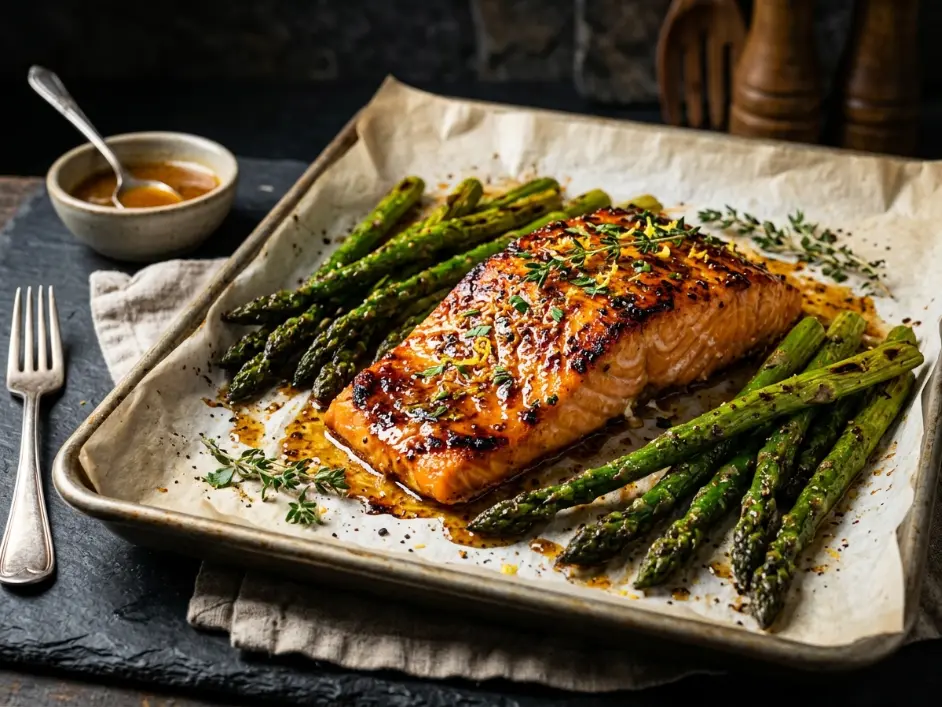
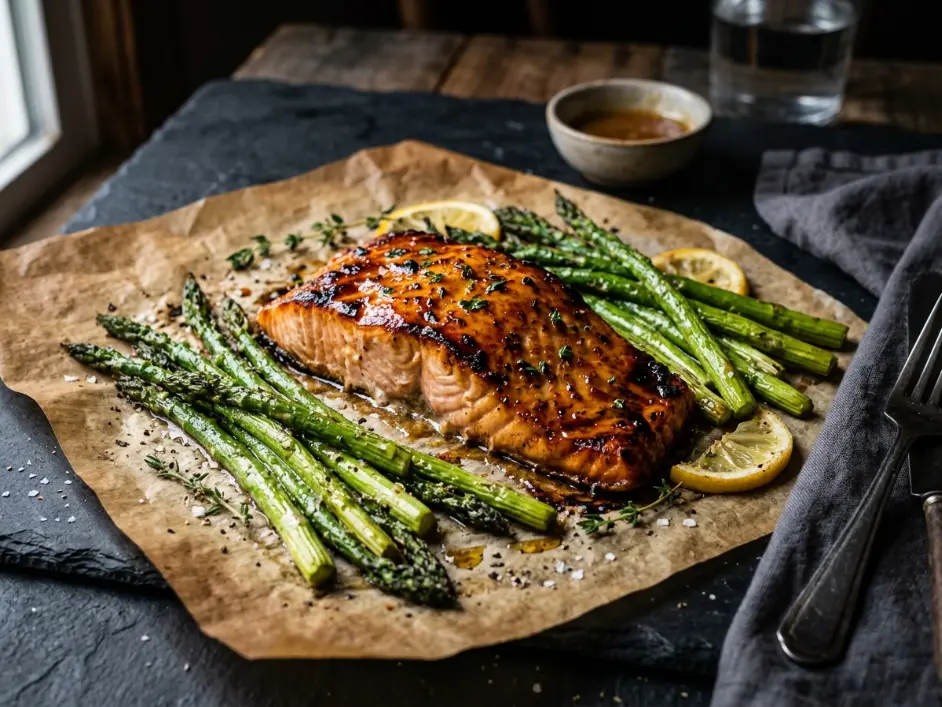
Imagine biting into a thick, center-cut salmon fillet with skin that’s crispy and caramelized, while the interior is buttery, translucent, and impossibly moist. The honey mustard glaze has deepened into a burnished amber lacquer—glossy, velvety, and clinging to every flake of flesh. The asparagus spears are vibrant emerald, tender-crisp with charred edges that taste slightly sweet from caramelized sugars. The plate is a study in contrast and harmony.
Now flip that script. The disastrous reality: a chalky, gray, overcooked salmon fillet weeping white albumin rivulets across the plate. The honey mustard glaze has burned into black, acrid-tasting char. The asparagus has shriveled into woody, bitter sticks. The sheet pan dinner tastes like a cooking mistake instead of a sophisticated weeknight meal.
I have tested this method across dozens of batches in the Expert Palate test kitchen, adjusting one variable at a time to isolate exactly what makes the difference between a split, oily mess and a perfectly bound, velvety emulsion. The sheet pan honey mustard salmon and asparagus requires understanding the precise thermal relationships between protein coagulation thresholds, carbohydrate pyrolysis temperatures, and moisture gradient management.
This is where most home cooks catastrophically fail. They use uneven salmon sizes. They apply glaze too early causing scorching. They crowd asparagus too densely creating steam pockets. One misstep and your dinner becomes a textural and flavor disaster.
But master the molecular science of glaze physics, and you’ll own a restaurant-quality weeknight meal that tastes like you spent three hours perfecting technique instead of exactly thirty-five minutes in your kitchen.
3 Unrivaled Secrets to Prevent Disastrous Greasy Easy Smashed Burger Tacos with Secret Sauce
The Molecular Science of Glaze Caramelization for Flawless Sheet Pan Honey Mustard Salmon and Asparagus
Here’s the precise molecular reality happening inside your oven during the roasting cycle. Salmon flesh is approximately 65% water, 25% protein (predominantly myosin and collagen), and 10% omega-3 lipids. The entire dish depends on managing protein coagulation timing and preserving lipid structure against thermal damage.
When oven radiant heat enters the system, salmon proteins begin denaturing (unraveling) at around 120°F / 49°C. This protein restructuring is essential—it transforms raw translucent fish into cooked opaque pink. But here’s the trap: if you exceed 135°F / 57°C, the myosin proteins denature completely and squeeze out their bound water molecules as white albumin—that unappealing white foam that runs across your plate.
In simple terms: Undercooked salmon tastes mushy and raw. Perfectly cooked salmon is buttery and translucent-pink inside. Overcooked salmon is chalky, gray, and weeps white protein rivulets everywhere.
The thermal window for salmon is surprisingly forgiving compared to most seafood—you have roughly 10-15 minutes of cooking time before crossing from perfect to ruined. But precision still matters because carryover cooking continues pushing the internal temperature upward even after you remove the pan from heat.
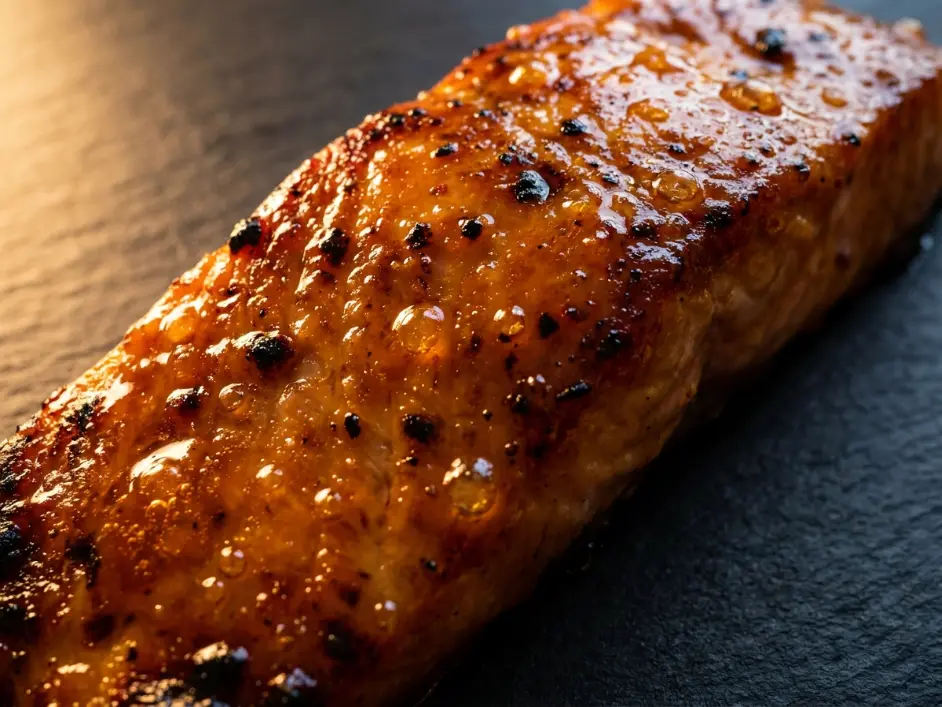
The honey mustard glaze adds extraordinary complexity. Honey is approximately 80% carbohydrates (glucose and fructose) with trace proteins and enzymes. When you heat honey above 300°F / 149°C, the carbohydrates undergo pyrolysis—a chemical decomposition process that breaks glucose and fructose molecules into hundreds of new compounds. These compounds create deep golden-brown color, complex sweetness, and caramelized aromatics.
But exceed 350°F / 176°C and the carbohydrates convert into charred, bitter-tasting carbon compounds. You’ve crossed the line from beautifully caramelized to burnt and acrid. This temperature threshold is critical because honey’s low water content means it concentrates rapidly and temperatures spike fast on a hot sheet pan.
Whole-grain mustard acts as an emulsion stabilizer. The mustard seed mucilage contains proteins and plant oils that behave similarly to lecithin in egg yolks—they allow the glaze to stay unified instead of separating into greasy pools. When you combine honey, mustard, and a touch of acid (lemon juice or vinegar), you create a stable suspension that clings to the salmon skin through multiple heating cycles.
The asparagus component presents its own thermal challenges. Asparagus is approximately 92% water with significant fiber content and chlorophyll. When you expose asparagus to heat above 200°F / 93°C for extended periods, the chlorophyll begins converting into pheophytin—a dull olive-gray pigment. The water evaporates, concentrating sugars and creating opportunities for Maillard browning at the cut surfaces and charred edges.
Crucially, asparagus fiber softens through cellulose hydrolysis. The cell walls are primarily composed of cellulose and hemicellulose—long-chain sugar polymers. When exposed to steam or moist heat around 190-210°F / 88-99°C, these polymers absorb water and soften, making the asparagus tender-crisp. But if asparagus sits in moisture too long or crowded in a pan, it stews instead of roasting and becomes mushy and flabby.
The interplay between all three components requires exquisite thermal balance. You need high enough heat to caramelize the glaze and char the asparagus edges, but not so high that salmon overheats and the glaze burns before the asparagus finishes softening.
Salmon Myosin Coagulation+Honey Carbohydrate Pyrolysis+Asparagus Fiber Hydrolysis→Unified Textural Harmony
Analyzing the raw structural properties, cellular lipid densities, and nutrient profiles of salmon fillets scales accurately by checking verified biochemical datasets from the global FoodData Central database. Wild-caught salmon typically contains approximately 11-20g omega-3 lipids per 100g raw weight depending on season and species, with myosin protein density around 20-22g per 100g. These lipid profiles directly impact heat transfer rates and protein denaturation temperatures.
Pro Sourcing & Ingredient Selection
Start with salmon quality. Look for King salmon (also called Chinook) when available—it has higher fat content (around 15-20% omega-3s) than Atlantic salmon, which means it’s more forgiving during cooking and delivers superior silkiness. The fat content also means less white albumin leakage because lipids don’t coagulate and separate like proteins do.
For salmon sizing, choose center-cut fillets that are uniform in thickness—ideally 1.5 to 2 inches / 3.8 to 5cm thick. Center-cut pieces cook more evenly than tail sections which are thin and cook too quickly. Uniform thickness across the fillet is essential because thick and thin areas reaching doneness simultaneously requires this uniformity.
Look for salmon with intact, shiny skin showing iridescent color. Skip fillets with dull, grayish skin—that indicates age or improper storage. The flesh should be firm, not mushy or soft when gently pressed. A quality salmon fillet should spring back immediately when poked.
For honey, seek raw, unfiltered, unheated honey from local beekeepers when possible. Processed supermarket honey has been heated and filtered, destroying enzymatic compounds and micronutrients. Raw honey’s natural enzymes and pollen actually enhance flavor complexity when combined with mustard’s aromatics. The honey should be thick but pourable at room temperature.
For mustard, use whole-grain Dijon or creole-style mustard—not smooth yellow mustard. The mustard seed particles act as emulsion stabilizers and add textural complexity. Smooth mustard lacks the mucilage density needed for proper glaze binding.
For asparagus, select medium-gauge spears—roughly pencil-thickness. Thin asparagus (like pencil-thin or thinner) cooks too fast and turns mushy. Thick asparagus (thicker than your pinky) takes forever to soften and the outer surface burns before the center cooks. Medium gauge—roughly 0.25 to 0.4 inch / 6 to 10mm in diameter—provides the perfect balance.
Comprehensive Ingredients Table
| Category | Ingredient | US Customary | Metric |
|---|---|---|---|
| Marine Omega-3 Component | King salmon center-cut fillets (skin-on, uniform thickness) | 1.5 lbs | 680g |
| High-Mucilage Glaze Base | Raw unfiltered honey (thick, room temperature) | 0.5 cup | 120ml |
| Whole-grain or Dijon mustard (seed particle richness) | 3 tbsp | 45ml | |
| Coarse sea salt | 1 tsp | 6g | |
| Freshly cracked black pepper | 0.5 tsp | 1g | |
| Acid-Balance Brighteners | Fresh lemon juice (freshly squeezed) | 2 tbsp | 30ml |
| Lemon zest (finely grated) | 1 tbsp | 6g | |
| Balsamic vinegar (aged, optional depth) | 1 tbsp | 15ml | |
| Fibrous Botanical Accents | Fresh asparagus spears (medium gauge, trimmed) | 1.5 lbs | 680g |
| Surface Treatment & Finishing | Extra virgin olive oil (for pan lining) | 1 tbsp | 15ml |
| Fresh thyme sprigs (herbaceous aromatics) | 6 sprigs | 9g | |
| Garlic cloves (thinly sliced, optional) | 3 cloves | 15g |
Common Kitchen Blunders Matrix
| The Kitchen Blunder | What Actually Happens (Scientific Reality) | The Chef Joseph Fix |
|---|---|---|
| Using uneven salmon fillet sizes | Different thicknesses cook at different rates. Thin tail sections reach 135°F / 57°C internal temperature in 8-10 minutes while thick shoulder sections require 15-18 minutes. By the time the thick section reaches doneness, the thin section has overcooked into chalky texture and begun weeping white albumin. You end up with inconsistent doneness across a single fillet. | Choose center-cut salmon fillets that are uniform in thickness across the entire piece. Ideally 1.5 to 2 inches / 3.8 to 5cm throughout. If you only have tapered fillets, tuck the thin tail section underneath the thicker shoulder section so it cooks slower and stays protected from direct heat. |
| Applying honey mustard glaze at the start of roasting | Honey carbohydrates are volatile at high temperatures. When exposed to 400°F+ / 204°C+ oven heat for the full 15-18 minute roasting period, the glaze burns from caramelization into charred, bitter-tasting carbon. The glaze turns black instead of amber, the mustard seeds burn and turn acrid, and the entire surface tastes scorched instead of sweet and umami-rich. | Apply the honey mustard glaze during the final 8-10 minutes of roasting only—after the salmon has already begun cooking and the internal structure has started setting. The shorter exposure time allows the glaze to caramelize beautifully into amber-gold without burning into bitter char. Alternatively, brush glaze on halfway through cooking and again near the end. |
| Crowding asparagus too densely on the sheet pan | Crowded asparagus creates microenvironments of moisture and steam around each spear. Instead of roasting (dry heat), the asparagus stews in its own released water. The moisture prevents Maillard browning at the surface, keeps the exterior pale green instead of allowing charring, and creates a limp, mushy texture instead of tender-crisp. The asparagus essentially steams instead of roasts. | Arrange asparagus in a single layer with visible gaps between spears—roughly 0.5 to 1 inch / 1.3 to 2.5cm between each piece. This spacing allows hot oven air to circulate around all surfaces, promoting even roasting and browning instead of steam accumulation. Less is more with sheet pan crowding. |
| Not patting salmon dry before seasoning | Surface moisture prevents the glaze from adhering properly. Water acts as a barrier between the glaze and the salmon skin. Instead of the glaze coating the fish, it sits on top of water droplets and slides off during roasting or pools at the bottom of the pan. The glaze doesn’t adhere uniformly and you lose the beautiful caramelized coating that defines this dish. | Pat the salmon fillets completely dry with paper towels before seasoning. Spend 30 seconds per fillet rubbing away all surface moisture. Dry salmon skin accepts the glaze and allows it to adhere through protein-carbohydrate bonding during the roasting cycle. This drying step is non-negotiable for success. |
| Roasting at too high a temperature to save time | Extreme heat (425°F+ / 218°C+) causes uneven cooking. The exterior of the salmon reaches 135°F / 57°C doneness while the center is still 115°F / 46°C raw. Additionally, high heat causes the glaze to burn before it has time to caramelize properly. You end up with charred glaze on the outside and undercooked, translucent-raw fish inside—the worst of both worlds. | Roast at 400°F / 204°C for consistent, even heating. This moderate temperature allows the salmon’s interior to cook through at the same rate the exterior is developing texture. The glaze has time to caramelize into beautiful amber without burning. Precision temperature matters more than aggressive heat. |
| Using pre-made honey mustard glaze from a jar | Commercial honey mustard contains stabilizers, thickeners, and preservatives that interfere with proper caramelization. The glaze often has corn syrup instead of real honey, which burns differently and tastes hollow. The glaze also contains high fructose corn syrup that begins caramelizing at lower temperatures and tastes artificial instead of rich and complex. You lose the authentic sweetness and mustard seed umami that defines this dish. | Make fresh honey mustard glaze by combining raw honey, whole-grain mustard, fresh lemon juice, and a pinch of salt in a bowl and whisking until emulsified. This fresh glaze delivers authentic flavor, proper caramelization properties, and superior adhesion to the salmon. Fresh always outperforms commercial pre-made versions in texture and taste. |
Master Step-by-Step Method
Surface Moisture Evaporation and Preparation Phase
Begin by preheating your oven to 400°F / 204°C. Place a sheet pan lined with parchment paper inside the oven to preheat simultaneously. A hot pan ensures rapid moisture evaporation from the salmon bottom and promotes Maillard browning at the contact surface between salmon skin and pan.
Pat your salmon fillets completely dry with paper towels, spending 30 seconds per piece rubbing away all surface moisture. This drying is absolutely essential—wet surfaces prevent glaze adhesion and can create steam pockets that soften the skin instead of crisping it.
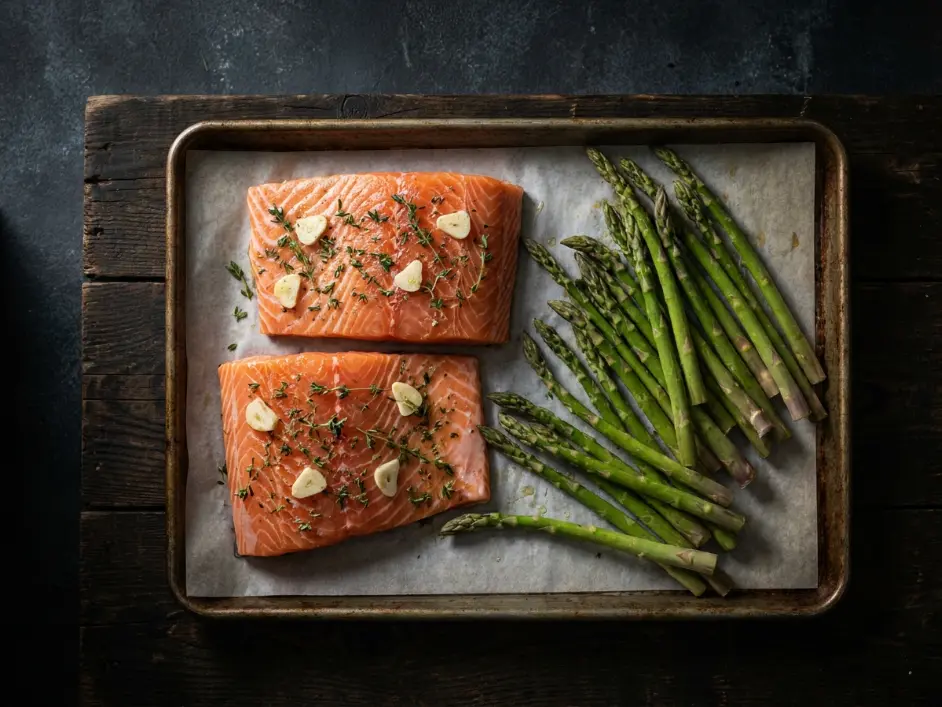
Arrange the dried salmon fillets skin-side down on the preheated parchment-lined sheet pan. Space them at least 1 inch / 2.5cm apart. Never crowd—each fillet needs direct heat exposure to develop proper texture. Brush or lightly rub the top (flesh side) of each fillet with a tiny amount of extra virgin olive oil.
Season the salmon with coarse sea salt and cracked black pepper on the top surface only. Salt the flesh side generously—the flesh will absorb the seasoning, but the skin already has enough surface salinity. Arrange fresh thyme sprigs on top of each fillet and scatter optional thinly sliced garlic cloves across the flesh.
Viscous Glaze Application and Initial Roasting Phase
Combine 0.5 cup / 120ml of raw unfiltered honey, 3 tablespoons / 45ml of whole-grain mustard, 2 tablespoons / 30ml of fresh lemon juice, 1 tablespoon / 15ml of balsamic vinegar (optional), and 1 pinch of sea salt in a small bowl. Whisk gently for 30 seconds until the mixture becomes uniform in color and texture—the mustard seed particles should distribute evenly throughout the honey.
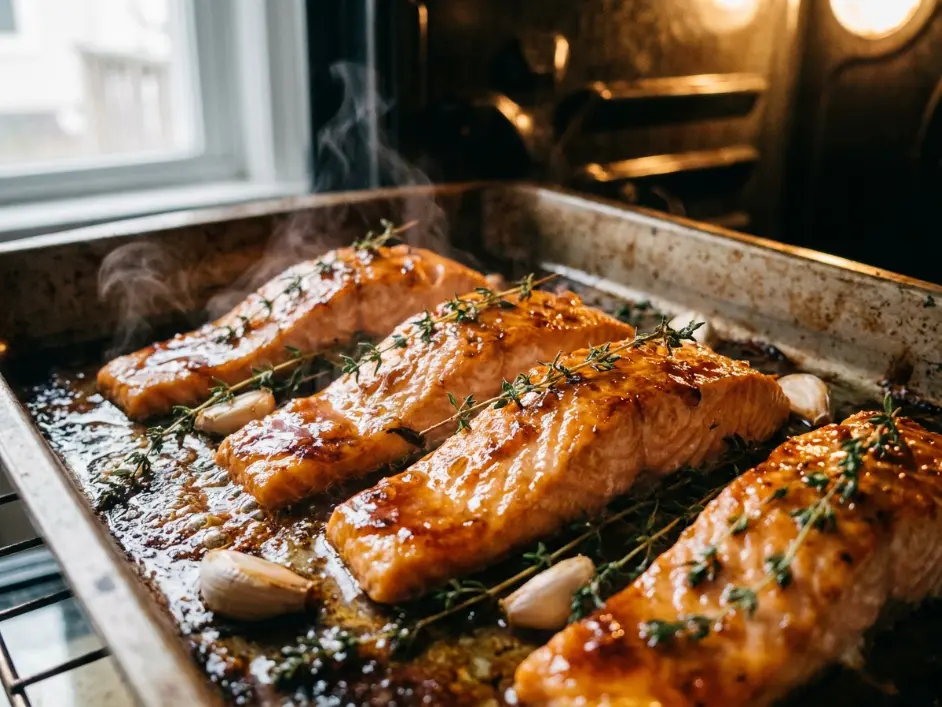
After the salmon has roasted for exactly 8 minutes (allowing the flesh to begin setting and proteins to denature without yet reaching peak doneness), remove the sheet pan from the oven. Brush or spoon approximately 1 tablespoon / 15ml of the honey mustard glaze onto the top (flesh side) of each salmon fillet, using the back of a spoon to spread it evenly across the surface.
Immediately return the sheet pan to the oven for another 3 minutes. This brief exposure allows the carbohydrates in the honey to begin caramelizing into golden-amber without having time to burn into bitter char. The glaze will bubble and deepen in color as sugars caramelize.
Remove the sheet pan again at the 11-minute mark. Brush a second thin layer of glaze (approximately 0.5 tablespoon / 7.5ml per fillet) across each salmon fillet. This second coat ensures you achieve a glossy, caramelized crust without scorching.
Radiant Thermal Finishing and Asparagus Integration Phase
During this second glaze application moment, quickly arrange the asparagus spears on the hot sheet pan in a single layer around the salmon fillets. Position them with visible gaps between spears—roughly 0.5 to 1 inch / 1.3 to 2.5cm between pieces. Toss the asparagus with the tiniest drizzle of extra virgin olive oil, coarse sea salt, and cracked black pepper.
Return the sheet pan to the oven for exactly 6-8 more minutes. During this final phase, multiple cooking events are occurring simultaneously: The salmon internal temperature is reaching the perfect 125-135°F / 52-57°C sweet spot where myosin proteins are fully denatured but haven’t begun squeezing out water. The honey mustard glaze is deepening into burnished amber with slight char marks at the edges. The asparagus is wilting from fiber hydrolysis, developing vibrant golden-brown caramelization on the surface, and the cut ends are showing slight char.
Check the salmon doneness at the 17-minute total roasting mark by inserting an instant-read thermometer into the thickest part of the salmon. You’re aiming for 130°F / 54°C internal temperature. If it reads lower, return to the oven for 1-2 more minutes. If it reads 135°F / 57°C or higher, remove immediately—you’re approaching the overcooked threshold.
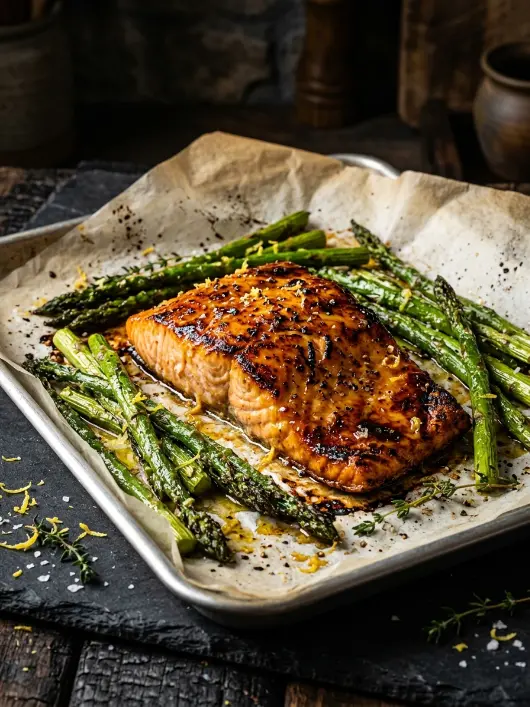
Remove the sheet pan from the oven. At this point, you should observe: Deep amber caramelized glaze clinging to the salmon surface with slight char marks visible. Crispy, curled asparagus edges with vibrant green color preserved throughout. The salmon interior still showing translucent pink flesh while the exterior is cooked firm.
Squeeze fresh lemon juice across the entire sheet pan contents immediately—the acidity adds brightness and cuts through the richness of the honey glaze. Scatter additional fresh lemon zest across everything for aromatic depth.
Advanced texture-building techniques thoroughly mapped out over at Serious Eats prove why precision timing and surface management loops ensure absolute success in sheet pan roasting. The difference between mediocre and extraordinary is understanding these thermal curves and respecting the molecular physics driving every texture transformation.
Cooking is not just chemistry — it is memory made edible. When others gather around a table and tear off that first piece of warm, crunchy bread to plunge it into a bubbling, velvety center, the science fades away and pure connection takes over. The most powerful moves in the kitchen are almost always the quiet ones. The overnight rest. The proper preheat. The two-minute wait before you plate. It is the patience to wring out every last drop of moisture from your greens, and the care you take in picking the right cheese. Take your time, respect the process, and your kitchen will always reward you. — Chef Joseph | Expert Palate
6 Unrivaled Culinary Secrets to Avoid Disastrous Dry Dump-and-Go Crockpot BBQ Pulled Pork Sandwiches
Technical Data & Nutrition Table
| Nutrient | Per Serving (Approximately 6 oz / 170g Salmon with 4 oz / 115g Asparagus) |
|---|---|
| Calories | 385 kcal |
| Protein | 42g |
| Total Fat | 18g |
| Saturated Fat | 3g |
| Carbohydrates | 22g |
| Dietary Fiber | 3g |
| Sodium | 480mg |
| Cholesterol | 85mg |
Note: Nutrition values are careful kitchen estimates based on standard ingredient composition databases. Actual values may vary depending on specific salmon species, asparagus thickness, and exact glaze application amounts per fillet.
Food Safety & Thermal Management
Salmon requires reaching a safe internal structure where myosin proteins have denatured sufficiently to eliminate any potential parasites or pathogens, typically at around 125∘F/52∘C to 135∘F/57∘C. At this temperature threshold, the salmon interior is translucent-pink and buttery, indicating complete protein denaturation while retaining moisture. Visual doneness cues (opacity, slight firmness when pressed) are reliable indicators that food-safety thresholds have been met for wild-caught salmon.
The standard danger zone for bacterial growth in seafood occurs between 40∘F−140∘F/4∘C−60∘C. Never leave your prepared sheet pan honey mustard salmon and asparagus sitting at room temperature for more than 1 hour. Once cooked and the salmon reaches 125∘F/52∘C, it must remain above 140∘F/60∘C during storage or service to maintain food safety margins.
Executing large-batch sheet pan spreads safely for hot gatherings or buffet lines requires adhering to the safe holding parameters curated over at the Food Network. For hot holding, keep finished salmon and asparagus on a warming tray at 140−150∘F/60−65∘C for no longer than 2 hours. Beyond this time window, the salmon’s delicate proteins continue denaturing, the fish becomes chalky and gray, and white albumin begins leaching onto the plate surface.
Storage & Reheating Matrix
| Storage State | Fridge Limit | Freezer Option | Best Reheating Method |
|---|---|---|---|
| Fully Cooked Salmon and Asparagus with Honey Mustard Glaze | 2-3 days in airtight container | Up to 2 months in freezer-safe container, though texture quality degrades significantly upon thawing. The glaze becomes sticky instead of glossy and the salmon becomes slightly dry. | Reheat gently in a preheated 300°F / 149°C oven wrapped loosely in foil for 8-10 minutes until warmed through. The low, gentle heat preserves the salmon’s delicate protein structure instead of shattering it. Alternatively, place on a plate covered with a damp paper towel and microwave at 30% power for 2-3 minutes, checking frequently. Never use full microwave power—intense electromagnetic radiation destroys the salmon’s protein fiber architecture and turns the flesh rubbery and dense. |
| Cooked Salmon Only (Without Asparagus or Glaze) | 2-3 days in airtight container | Up to 3 months in vacuum-sealed bag | Reheat gently in a 300°F / 149°C oven loosely wrapped in foil for 6-8 minutes. Watch carefully as reheated salmon can dry out rapidly. Alternatively, flake cold salmon and incorporate into pasta, salads, or grain bowls where additional moisture from other components masks any texture degradation. |
| Cooked Asparagus Only (Without Salmon or Glaze) | 3-4 days in airtight container | Up to 3 months in freezer | Reheat gently in a skillet over medium heat for 2-3 minutes stirring occasionally. The asparagus tolerates reheating better than delicate salmon tissue. You can also consume cold directly from the refrigerator as a salad component or snack without quality loss. |
Sheet Pan Honey Mustard Salmon and Asparagus
Ingredients
Equipment
Method
- Preheat oven to four hundred degrees Fahrenheit and place sheet pan lined with parchment paper inside to preheat simultaneously ensuring hot surface for rapid moisture evaporation.
- Pat salmon fillets completely dry with paper towels spending thirty seconds per piece removing all surface moisture to allow glaze adhesion and skin crisping.
- Arrange dried salmon fillets skin-side down on preheated parchment-lined sheet pan spacing them at least one inch apart to ensure individual heat exposure and prevent crowding.
- Brush or lightly rub the top flesh side of each salmon fillet with a tiny amount of extra virgin olive oil then season with coarse sea salt and cracked black pepper on flesh side only.
- Arrange fresh thyme sprigs on top of each salmon fillet and scatter optional thinly sliced garlic cloves across the flesh for herbaceous aromatics.
- Roast salmon in preheated four hundred degree oven for exactly eight minutes allowing flesh to begin setting and proteins to denature without reaching peak doneness threshold.
- Combine raw unfiltered honey whole-grain mustard fresh lemon juice balsamic vinegar and sea salt in small bowl whisking gently for thirty seconds until mixture becomes uniform in color and texture.
- Remove sheet pan from oven at eight-minute mark and brush or spoon approximately one tablespoon of honey mustard glaze onto the top flesh side of each salmon fillet spreading evenly.
- Return sheet pan to oven immediately and roast for exactly three minutes allowing honey carbohydrates to caramelize into golden-amber without burning into bitter char.
- Remove sheet pan again at eleven-minute total roasting mark and brush second thin layer of glaze approximately half tablespoon per fillet across each salmon fillet ensuring glossy caramelized crust.
- Quickly arrange medium-gauge asparagus spears on hot sheet pan in single layer around salmon fillets positioning with visible gaps roughly half to one inch between spears.
- Toss asparagus with tiniest drizzle of extra virgin olive oil coarse sea salt and cracked black pepper coating evenly for roasting.
- Return sheet pan to oven for exactly six to eight minutes until salmon internal temperature reaches one hundred thirty degrees Fahrenheit and asparagus develops charred edges and vibrant golden-brown color.
- Check salmon doneness at seventeen-minute total roasting mark by inserting instant-read thermometer into thickest part aiming for one hundred thirty degrees Fahrenheit internal temperature.
- Remove from oven immediately when temperature reaches target ensuring carryover heat brings salmon to perfect one hundred thirty-five degrees while resting outside oven.
- Squeeze fresh lemon juice across entire sheet pan contents immediately adding brightness and acidity that cuts through richness of honey glaze.
- Scatter additional fresh lemon zest across everything for aromatic depth and visual garnish completing the finished dish.
Notes
Apply honey mustard glaze during final eight to ten minutes of roasting only after salmon has begun cooking allowing glaze to caramelize beautifully into amber-gold without burning into bitter char.
Arrange asparagus in single layer with visible gaps between spears allowing hot oven air to circulate around all surfaces promoting even roasting and browning instead of steam accumulation.
Check salmon internal temperature with instant-read thermometer at one hundred thirty degrees Fahrenheit for perfect doneness where myosin proteins are fully denatured without squeezing out water.
Use preheated sheet pan lined with parchment immediately before adding salmon ensuring hot surface renders skin fat and creates moisture seal that prevents sticking to paper.
Frequently Asked Culinary Questions
Why did my salmon turn out chalky and gray with white albumin leaking everywhere?
Salmon was roasted too long, pushing internal temperature above 135°F / 57°C. At this threshold, myosin proteins denature completely and squeeze out their bound water as white albumin. The key is using an instant-read thermometer to verify 130°F / 54°C internal temperature at the thickest part of the fillet. Remove immediately at this temperature—carryover heat will push it to 135°F / 57°C safely while the fish rests briefly outside the oven.
Can I use frozen salmon for this recipe, or should I use fresh?
Fresh wild-caught salmon delivers superior texture and flavor. Frozen salmon that’s been thawed compromises myofibrillar protein structure through ice crystal formation during freezing. When cooked, thawed salmon releases excess water and becomes mushy. If you must use frozen, buy individually quick-frozen (IQF) salmon and thaw immediately before cooking in cold running water (15-20 minutes). Never thaw in advance or at room temperature. Fresh salmon cooked immediately provides the most predictable, foolproof results.
Why did my honey mustard glaze burn into bitter black instead of beautiful amber?
The glaze was applied at the beginning of roasting instead of during the final 8-10 minutes. Honey carbohydrates are volatile at high temperatures—they burn rapidly when exposed to 400°F+ / 204°C+ heat for prolonged periods. Apply the glaze only during the final cooking phase after the salmon has begun setting. A second thin glaze layer near the end deepens the color without allowing time for burning. This two-stage glaze application creates beautiful caramelization without bitterness.
What thickness asparagus should I use?
Medium-gauge spears—roughly pencil-thickness (0.25 to 0.4 inch / 6 to 10mm in diameter). Thin asparagus cooks too fast and turns mushy before the salmon finishes. Thick asparagus (thicker than your pinky finger) takes forever to soften and the exterior burns while the center remains tough. Medium gauge provides the perfect balance—it softens through fiber hydrolysis in the 6-8 minutes that salmon requires for final cooking, developing charred edges and maintaining tender-crisp texture.
How do I prevent the salmon skin from sticking to the parchment paper?
Use a hot preheated sheet pan lined with parchment before adding salmon. The hot surface immediately begins rendering the salmon skin’s fat and creating a moisture seal that prevents sticking. Ensure you place the salmon skin-side down (not skin-side up) on the hot parchment. Pat the salmon completely dry before seasoning—moisture prevents skin from adhering to the pan and causes sticking. Follow this approach religiously and sticking becomes virtually impossible.