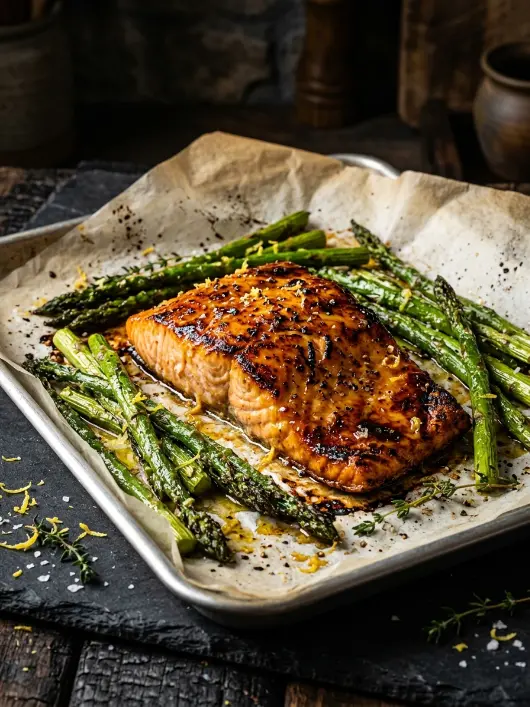
Ingredients
Equipment
Method
- Preheat oven to four hundred degrees Fahrenheit and place sheet pan lined with parchment paper inside to preheat simultaneously ensuring hot surface for rapid moisture evaporation.
- Pat salmon fillets completely dry with paper towels spending thirty seconds per piece removing all surface moisture to allow glaze adhesion and skin crisping.
- Arrange dried salmon fillets skin-side down on preheated parchment-lined sheet pan spacing them at least one inch apart to ensure individual heat exposure and prevent crowding.
- Brush or lightly rub the top flesh side of each salmon fillet with a tiny amount of extra virgin olive oil then season with coarse sea salt and cracked black pepper on flesh side only.
- Arrange fresh thyme sprigs on top of each salmon fillet and scatter optional thinly sliced garlic cloves across the flesh for herbaceous aromatics.
- Roast salmon in preheated four hundred degree oven for exactly eight minutes allowing flesh to begin setting and proteins to denature without reaching peak doneness threshold.
- Combine raw unfiltered honey whole-grain mustard fresh lemon juice balsamic vinegar and sea salt in small bowl whisking gently for thirty seconds until mixture becomes uniform in color and texture.
- Remove sheet pan from oven at eight-minute mark and brush or spoon approximately one tablespoon of honey mustard glaze onto the top flesh side of each salmon fillet spreading evenly.
- Return sheet pan to oven immediately and roast for exactly three minutes allowing honey carbohydrates to caramelize into golden-amber without burning into bitter char.
- Remove sheet pan again at eleven-minute total roasting mark and brush second thin layer of glaze approximately half tablespoon per fillet across each salmon fillet ensuring glossy caramelized crust.
- Quickly arrange medium-gauge asparagus spears on hot sheet pan in single layer around salmon fillets positioning with visible gaps roughly half to one inch between spears.
- Toss asparagus with tiniest drizzle of extra virgin olive oil coarse sea salt and cracked black pepper coating evenly for roasting.
- Return sheet pan to oven for exactly six to eight minutes until salmon internal temperature reaches one hundred thirty degrees Fahrenheit and asparagus develops charred edges and vibrant golden-brown color.
- Check salmon doneness at seventeen-minute total roasting mark by inserting instant-read thermometer into thickest part aiming for one hundred thirty degrees Fahrenheit internal temperature.
- Remove from oven immediately when temperature reaches target ensuring carryover heat brings salmon to perfect one hundred thirty-five degrees while resting outside oven.
- Squeeze fresh lemon juice across entire sheet pan contents immediately adding brightness and acidity that cuts through richness of honey glaze.
- Scatter additional fresh lemon zest across everything for aromatic depth and visual garnish completing the finished dish.
Notes
Pat salmon completely dry before seasoning ensuring glaze adheres through protein-carbohydrate bonding instead of sitting on water droplets and sliding off during roasting.
Apply honey mustard glaze during final eight to ten minutes of roasting only after salmon has begun cooking allowing glaze to caramelize beautifully into amber-gold without burning into bitter char.
Arrange asparagus in single layer with visible gaps between spears allowing hot oven air to circulate around all surfaces promoting even roasting and browning instead of steam accumulation.
Check salmon internal temperature with instant-read thermometer at one hundred thirty degrees Fahrenheit for perfect doneness where myosin proteins are fully denatured without squeezing out water.
Use preheated sheet pan lined with parchment immediately before adding salmon ensuring hot surface renders skin fat and creates moisture seal that prevents sticking to paper.
Apply honey mustard glaze during final eight to ten minutes of roasting only after salmon has begun cooking allowing glaze to caramelize beautifully into amber-gold without burning into bitter char.
Arrange asparagus in single layer with visible gaps between spears allowing hot oven air to circulate around all surfaces promoting even roasting and browning instead of steam accumulation.
Check salmon internal temperature with instant-read thermometer at one hundred thirty degrees Fahrenheit for perfect doneness where myosin proteins are fully denatured without squeezing out water.
Use preheated sheet pan lined with parchment immediately before adding salmon ensuring hot surface renders skin fat and creates moisture seal that prevents sticking to paper.