Ingredients
Equipment
Method
- Pour two cups cultured full-fat buttermilk into large bowl and whisk in two teaspoons coarse sea salt and one teaspoon freshly cracked black pepper until salt dissolves completely.
- Pat chicken tenderloin strips or thin-sliced breast pieces completely dry with paper towels removing all surface moisture to enable proper marinade penetration.
- Submerge dried chicken pieces into seasoned buttermilk ensuring every piece is completely covered by liquid and weighting down with small plate if necessary to keep submerged.
- Cover container and refrigerate for exactly two hours allowing lactic acid to penetrate myofibrillar protein structure and enzymatic proteolysis to tenderize muscle fibers without degrading protein structure excessively.
- In shallow bowl or baking pan combine one and one-half cups low-protein pastry flour one cup cornstarch and one-quarter cup optional tapioca starch whisking together until completely uniform.
- To flour-starch mixture add one tablespoon garlic powder one tablespoon onion powder one and one-half teaspoons smoked paprika one-half teaspoon optional cayenne pepper two teaspoons coarse sea salt and one teaspoon freshly cracked black pepper whisking thoroughly.
- After two-hour marinade remove chicken strips one at a time from buttermilk allowing excess to drip off naturally without vigorous shaking or squeezing.
- Dredge each buttermilk-coated strip thoroughly in flour-starch mixture pressing gently to ensure adhesion coating all surfaces evenly.
- Arrange dredged strips on clean wire rack in single layer allowing at least half-inch spacing between pieces and resting at room temperature for eight to ten minutes.
- Place deep Dutch oven or heavy pot on stovetop over medium-high heat and pour two quarts refined peanut oil or beef tallow into vessel.
- Clip accurate deep-fry thermometer to side of pot ensuring bulb is submerged in center of oil but not touching pot bottom and heat oil until thermometer reads exactly three hundred fifty degrees Fahrenheit.
- Once oil reaches target temperature carefully add four to five chicken strips to oil in first batch maintaining at least two to three inches spacing between pieces.
- Fry first batch for exactly three to four minutes depending on strip thickness monitoring color for golden-brown exterior and verifying internal temperature with instant-read thermometer reading one hundred sixty-five degrees Fahrenheit.
- Use slotted spoon or spider strainer to carefully remove fried strips from oil shaking off excess oil over pot and transferring to wire rack lined with paper towels.
- Allow oil temperature to recover back to three hundred fifty degrees Fahrenheit between batches approximately two to three minutes and repeat frying process with remaining chicken strips.
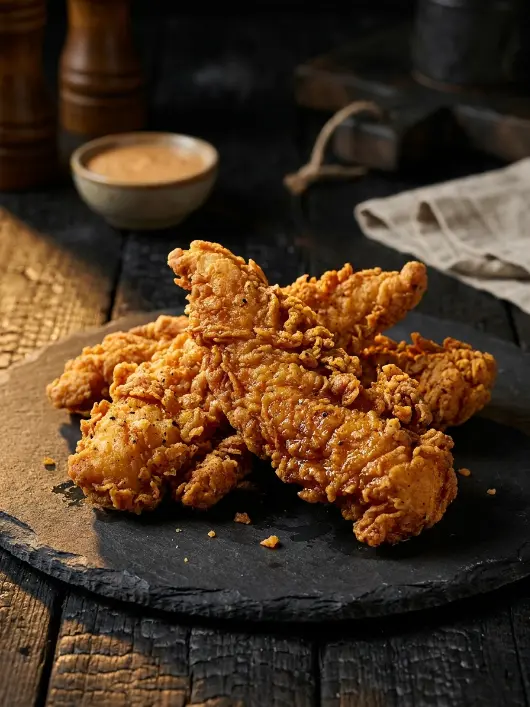
- All strips should achieve deeply golden-brown color with jagged peaks and valleys indicating proper starch gelatinization and water vapor vaporization relief throughout cooking.
- Serve immediately while crust is shatterproof and crisp and chicken interior remains impossibly tender and juicy from buttermilk enzymatic tenderization.
Notes
The two-hour buttermilk marinade window is non-negotiable for tender juicy results allowing lactic acid proteolysis to penetrate muscle fiber structure without degrading protein beyond salvageable texture.
The eight to ten minute resting period after dredging allows buttermilk moisture to migrate into flour creating molecular bonding that ensures crust adheres to chicken instead of floating free in oil.
Oil temperature precision is critical maintaining exactly three hundred fifty degrees Fahrenheit throughout frying batches using an accurate thermometer and allowing full recovery between batches prevents greasy saturation.
The flour-starch blend ratio of three parts low-protein flour to two parts cornstarch creates staggered gelatinization temperatures that produce mechanical strength through layered matrix structure resulting in shatterproof crispy crust.
Frying time of three to four minutes depending on strip thickness is determined by precise timing not visual doneness estimation ensuring consistent results across all batches.
The eight to ten minute resting period after dredging allows buttermilk moisture to migrate into flour creating molecular bonding that ensures crust adheres to chicken instead of floating free in oil.
Oil temperature precision is critical maintaining exactly three hundred fifty degrees Fahrenheit throughout frying batches using an accurate thermometer and allowing full recovery between batches prevents greasy saturation.
The flour-starch blend ratio of three parts low-protein flour to two parts cornstarch creates staggered gelatinization temperatures that produce mechanical strength through layered matrix structure resulting in shatterproof crispy crust.
Frying time of three to four minutes depending on strip thickness is determined by precise timing not visual doneness estimation ensuring consistent results across all batches.