Ingredients
Equipment
Method
- Combine three cups unbleached unbromated bread flour with one point five cups room-temperature unchlorinated water in a large mixing bowl stirring together using a wooden spoon or wet hand for one to two minutes until all dry flour particles are completely hydrated creating an extremely wet slack dough resembling thick batter rather than traditional bread dough.
- Cover the bowl loosely with a kitchen towel or plastic wrap and let it rest undisturbed at room temperature approximately seventy degrees Fahrenheit for twelve to eighteen hours allowing native protease enzymes to break down wheat proteins enzymatically without mechanical kneading. After eighteen hours the dough should display visible surface bubbles indicating yeast fermentation has occurred smell distinctly sour and yeasty and show slight doming from carbon dioxide gas production.
- Sprinkle one point five teaspoons fine sea salt and zero point five teaspoon instant yeast over the dough surface and gently fold into the mixture using five to ten wet hand folding motions.
- Cover the bowl again and let it rest at room temperature for thirty minutes to two hours allowing additional gas production and gluten strengthening.
- Preheat a heavy five to six quart cast-iron Dutch oven covered inside a four hundred fifty degree Fahrenheit oven for exactly forty-five minutes allowing the cast iron to reach maximum thermal capacity.
- Dust a work surface with flour and gently turn the fermented dough out using wet hands shaping it into a round boule by tucking the sides underneath to create surface tension.
- Place the shaped dough seam-side up into a floured banneton basket or seam-side down on a floured kitchen towel.
- Using a sharp single-edge lame razor blade make a single confident slash approximately zero point five inch deep at a forty-five degree angle across the top of the dough.
- Carefully remove the blazing-hot Dutch oven from the oven using oven mitts. Turn the dough out onto parchment paper and carefully place it inside the hot Dutch oven.
- Cover with the Dutch oven lid and bake for exactly twenty to twenty-five minutes. After twenty minutes check the internal dough temperature using an instant-read thermometer inserted into the thickest part the temperature should read approximately one hundred eighty degrees Fahrenheit indicating adequate starch gelatinization.
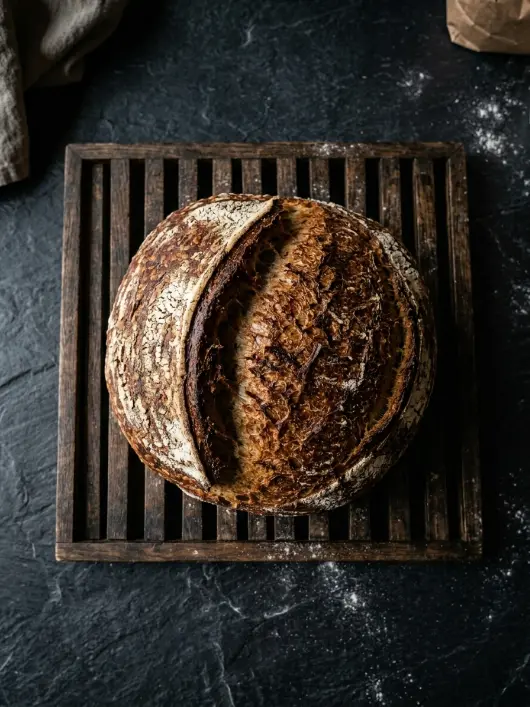
- Carefully remove the Dutch oven lid exposing the dough surface to direct radiant heat from the oven. Continue baking uncovered for another twenty to twenty-five minutes until the crust is deep mahogany brown and crackles when tapped with a wooden spoon.
- Remove the Dutch oven from the oven and carefully transfer the finished loaf to a wire cooling rack. Let the bread cool undisturbed for at least thirty minutes before slicing allowing the interior starch to set fully through retrogradation preventing gumminess inside the crumb.
Notes
Use room-temperature water not hot water because hot water accelerates yeast fermentation too rapidly preventing adequate enzyme-driven protein breakdown. Room temperature takes eighteen hours allowing optimal enzymatic action and flavor development. Do not skip the forty-five minute Dutch oven preheat because the thermal mass of heavy cast iron creates the intense steam pressure needed for maximum oven spring and open crumb expansion. Cold pots produce weak steam and result in tight dense crumbs. Ferment for exactly eighteen hours at room temperature not longer because over-fermentation causes the weak gluten network to rupture and the dough collapses losing all gas capacity before baking. Keep the Dutch oven covered for the full twenty to twenty-five minutes during the first phase because removing the lid prematurely stops steam generation and causes the interior to remain gummy while the crust hardens too fast. Use a sharp lame razor blade for scoring not a dull knife because dull blades drag through the delicate gluten sheets tearing them instead of cutting cleanly resulting in ugly random crust ruptures instead of beautiful controlled ear splits.